













How to create the perfect M&A brand strategy – 5 top tips for branding during a merger

Mergers and acquisitions (M&As) are commonplace in the business world. M&A transactions can give organizations the power to expand, access new customers, and increase revenue. Unfortunately, without the right M&A brand strategy, even the best partnerships can fail.
Mergers and acquisitions aren’t just financial transactions, after all, they’re transformative events. For two companies to join forces effectively, their values and brand identities need to be as well-aligned as their product portfolios and target audiences.
The most successful mergers and acquisitions of all time worked because the companies involved did their research, and built a brand identity that would resonate with external audiences (like customers), and internal team members, stakeholders, and investors.
So, how do you develop an effective M&A brand strategy?
Here’s everything you need to know.
What is an M&A brand strategy?
An M&A brand strategy is the process companies use to identify and implement the right brand identity after an M&A deal takes place. It could involve fusing significant elements of multiple brand identities together, championing one, stronger brand, or creating an entirely new brand identity.
Regardless of the end result, however, the focus of a M&A brand strategy is on ensuring the entity created by the combination of multiple companies is strong enough to retain existing customers, increase employee engagement, and attract new audience members.
After all, branding is a valuable tool. It’s not just a specific logo or color palette, it’s a culmination of elements that influences how people think and feel about a company.
Effective branding communicates a company’s reason for existing, highlighting how it meets the needs of investors, employees, and customers, and differentiating the organization from competitors.
Following a merger or acquisition, a well-crafted brand strategy helps to preserve or increase brand equity, keep team members engaged, and strengthen relationships with the most valuable customers of all the organizations involved.

Why are M&A branding strategies important?
The value of an M&A brand strategy can easily be overlooked by business leaders. The reason for this is that most companies view mergers and acquisitions from a financial perspective.
Leaders focus on increasing market share with new product lines, and the benefits they get from accessing the resources of other companies. However, the success of M&A transactions can often hinge on less tangible factors – including the resulting brand created by the two companies.
A successful merger requires a clear plan for how the connecting companies plan to reposition themselves in their market after they join forces.
Without an M&A brand strategy, confusion abounds. Employees are left uncertain about the goals, vision, and core values of the company. Customers lose track of the company’s value proposition, and what sets it apart from other organizations.
Even the customer experience can suffer, as internal teams struggle to determine how they should represent the brand when trying to attract the attention of their target audience.
Ultimately, an effective M&A branding strategy is how organizations ensure operational efficiency as they join forces, provide teams with clarity of purpose, and deliver a consistent message to their target audience. All of these things work together to boost the new entity’s chances of success.
4 common types of merger strategies
There are various ways to forge a path to growth after a merger or acquisition. Some of the largest acquisitions and mergers of all time have simply involved embedding a new company into a brand portfolio, following the “house of brands” strategy.
For instance, when Proctor & Gamble acquires a new company, the parent brand doesn’t shift its brand positioning, or change the appearance of the acquired brand. Everyone retains their own unique identity, and simply works together as part of a wider group.
However, an M&A brand strategy can also be a more involved process, which involves eliminating the elements of an acquired brand to champion the larger company, fusing two brand identities together, or creating an entirely new identity.
M&A brand strategy 1: No change
Probably one of the most common, and least risky ways to approach an M&A brand strategy, is to combine two companies without making any changes to their branding at all. After a brand acquisition, a parent company might decide to let the acquired company retain its image.
This is generally what happens when companies like P&G add new companies to their portfolio of brands. There’s no need for any company to make a significant change to their branding, because the parent company is already positioned as the “master brand” in the brand architecture.
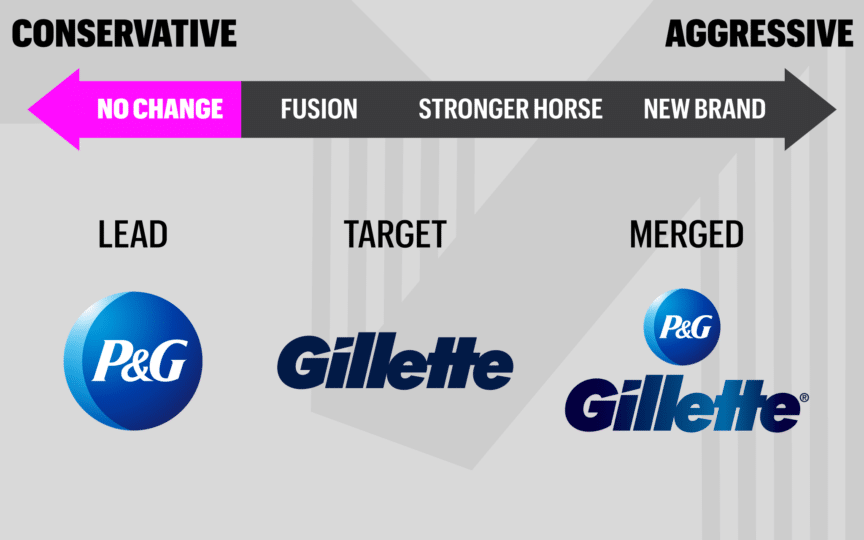
The “No change” strategy often makes sense when the brands joining forces are already clearly differentiated, and focus on a specific target market, product category, or group.
This approach can also make the process of combining companies a lot easier, as there’s a lot less work to do when it comes to building new marketing strategies, or training team members on how to operate according to new principles.
However, this method does still require careful planning. Teams still need to understand how the acquisition will affect how they create new products, serve customers, and represent the larger parent brand, otherwise disconnect can emerge between individual brands in a portfolio.
Careful planning is also crucial to ensure the acquiring company and the other brand gets the best value out of the M&A deal. Without a plan, synergies and new opportunities can go unrealized, making the purpose of the M&A obsolete.
M&A brand strategy 2: Fusion
The “fusion” approach to an M&A brand strategy is a little more complex. This method involves integrating key elements of brand identity from both companies in the acquisition, to create a new corporate identity.
Usually, there are a few different ways to approach a fusion, such as:
Straight fusion
Such as when two companies combine their names and logos to create a new entity. A good example of this is the “ExxonMobil” company, created after Exxon and Mobil decided to join forces in the technology sector.
Refreshed fusion
In a refreshed fusion strategy, the names of two companies are combined, but there’s usually a new logo to represent the company. For instance, ConocoPhillips created a new visual identity, even though the two companies combined their names.
Hybrid fusion
With hybrid fusion, the combined entity takes different elements from both brands. When United acquired Continental Airlines, the new brand used United’s name, but took aspects from the logo of Continental Airlines.
Endorsed fusion
In an endorsed fusion strategy, the bigger corporate brand or parent company endorses the new company. The Quest lineup of products is endorsed with the “Meta” name, for example.
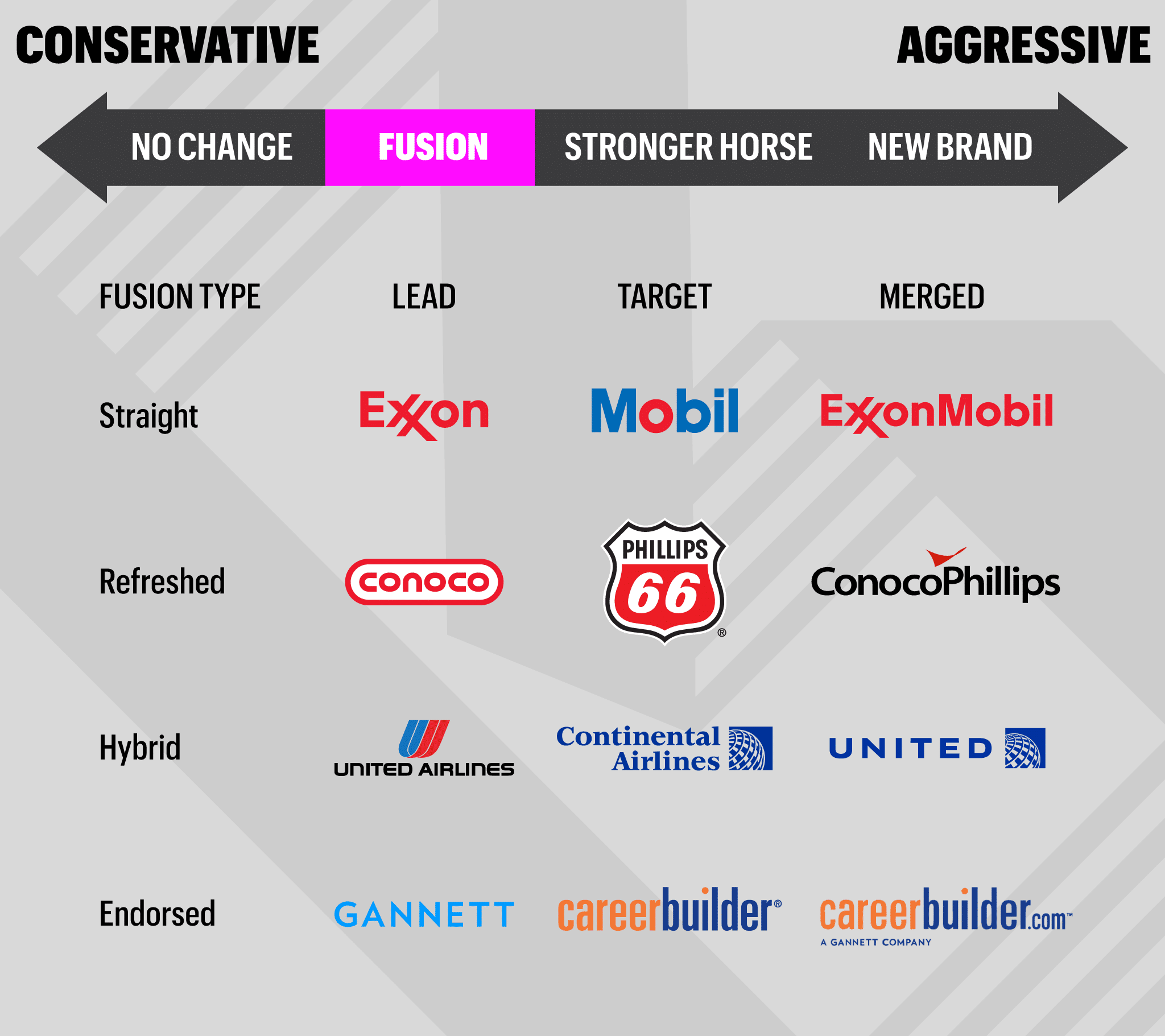
Fusion merger strategies are usually a method of managing risk. They help companies to avoid alienating customers and team members, by ensuring both companies, and specific elements of their brand identities survive the brand merger process.
M&A brand strategy 3: The stronger horse
The stronger horse strategy is a slightly more “aggressive” form of M&A brand strategy, where one company completely ‘overtakes’ another. Business leaders and M&A executives review the potential and brand equity of each company, and choose the ‘stronger’ brand.
The brand considered stronger might be the one that has a better reputation, less baggage, better sales numbers, or more potential from an investment perspective. After choosing the stronger brand, the merged entity takes on that company’s name, branding, and marketing strategies.
The other company is essentially ‘absorbed’ into the new entity, and all of its brand assets disappear, either eventually, or over time. When DHL acquired Airborne Express, for instance, the secondary brand was eliminated, and only DHL remained.
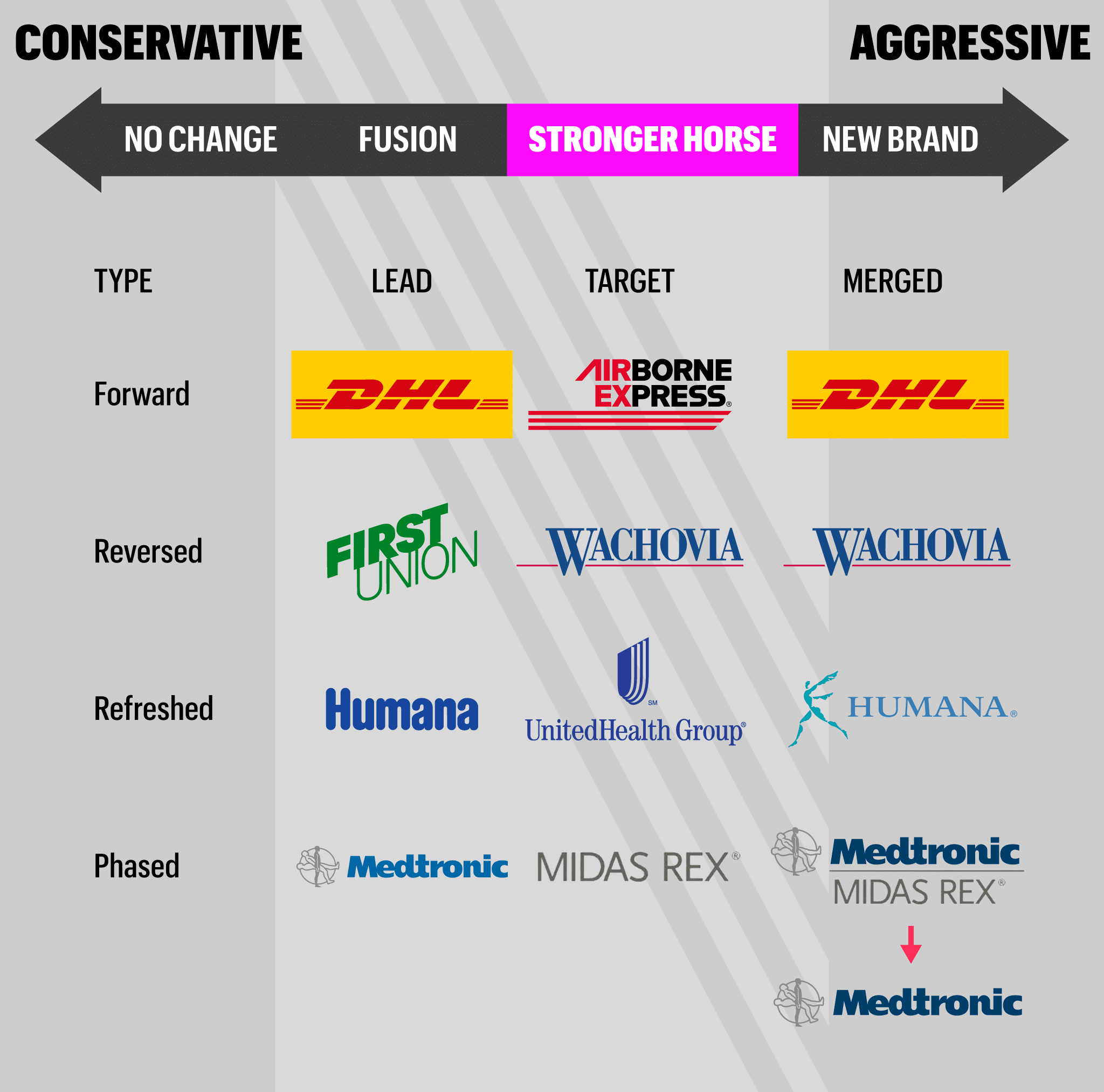
Notably, there are different ways to approach this framework too. There have been instances in the past where the smaller company in an M&A transaction absorbed the larger one. This is what happened when First Union acquired Wachovia.
Typically, this ‘reserve’ process happens when a larger brand needs to escape negative press or bad publicity. There are also instances when an “absorbed” brand won’t disappear straight away.
Some companies start with a fusion approach to build a strong foundation for the new company, without alienating existing stakeholders and audience members, then eventually transition to just using one company’s name and branding.
The good thing about this M&A brand strategy is that it creates a strong and clear vision for everyone involved. However, there’s a significant risk of alienating certain stakeholder groups, and harming team morale, as the framework creates a sort of ‘winner’ and a ‘loser’ in the M&A process.
M&A brand strategy 4: Creating a new brand
The final, and most complicated M&A brand strategy is to create an entirely new company. This is often considered the most aggressive way to approach the brand acquisition process.
Most established organizations prefer to avoid this method, as it means eliminating the equity already built by both companies. Starting from scratch means coming up with a new name, a new brand image, and a comprehensive plan for ongoing growth, without the assets you’ve already built.
However, this approach to an M&A deal can be useful in some circumstances, such as when two companies are joining forces to create an entirely different product portfolio, or target a new audience.
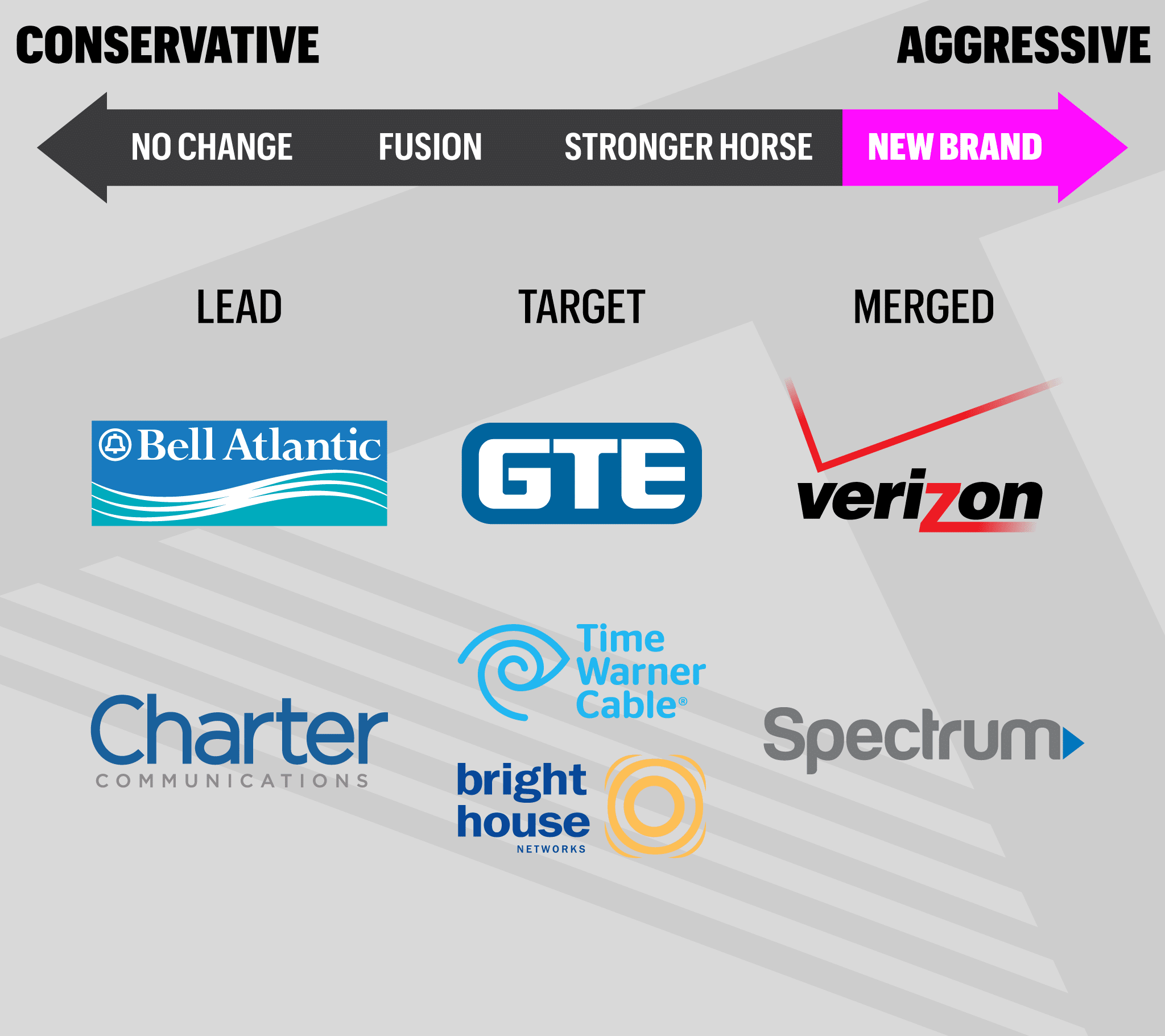
Some organizations also use the new brand strategy to signify a major transformation, such as when GTE and Bell Atlantic joined forces to create “Verizon”. The two companies wanted to separate themselves from their existing brand reputations and forge something new.
Of course, while creating a new brand can have its benefits, it’s also extremely risky. Investing in new branding is time-consuming and expensive. It basically means throwing all of your previous marketing efforts and branding strategies in the trash, and starting from day one.
5 tips for a stronger M&A brand strategy
Mergers and acquisitions might be common in the business world, but they’re not for the faint-hearted. According to some studies, the failure rate of most mergers and acquisitions ranges from around 70 to 90%, signifying how difficult it is to get the M&A process right.
While there are various factors that can influence the failure or success of a merger or acquisition, the wrong branding strategy is one of the most significant.
Ensuring you do your due diligence, examine the right key considerations, and implement a plan for building an effective future brand is crucial to M&A success.
Here are some top tips to get you on the right track.
1. Start with comprehensive research
Significant research and due diligence go into all acquisition and merger strategies, and the same should be true when it comes to developing your new brand strategy. Before you can decide on the right architecture for your brand, or how to position yourself, you need data.
Business leaders need to audit both brands, to learn as much as they can about the strengths and weaknesses of each company, and what should be retained during the branding process.
Asking questions like what customers think about both companies and the products they offer, what they’ll expect from the new company, and what vendors and employees think about each brand will help you to make strategic branding decisions.
A careful consideration of how current branding elements from both companies, such as logos, colors, and other brand imagery are perceived may help you to identify whether a fusion, stronger horse, or ‘no change’ strategy is right for your new organization too.
For instance, when the Private Equity Foundation and Impetus Trust joined forces, their analysis of their markets helped them to determine that retaining the names of both organizations in their new entity would help them to retain the trust of their respective audiences.

However, the merging companies decided to demonstrate progress and forward motion too, by creating a new image and visual identity to represent the new brand. This helped to ensure both organizations retained some of their reputation in the market, which paving the way for future growth.
2. Create a clear and aligned vision
The next step in developing a strong M&A brand strategy is defining a specific vision. Ultimately, your branding strategy should align with your wider business strategy for the new organization.
Ask yourself what you want to accomplish by bringing two or more companies together. Is your goal to completely transform customer perceptions, and separate the merging brands from their previous history in the market?
Is your goal to expand your solutions portfolio and connect with customers from different cultures and backgrounds with differentiated products?
What will the company you create do for your customers? What will it be able to accomplish that both of the individual brands can’t do as well alone? Identifying these factors is crucial.
This process will also ensure you can develop a clear purpose and messaging strategy for your new brand, making it easier to build powerful marketing campaigns that attract the right audience.
3. Establish a cohesive brand architecture and story
Once you’ve done your research into both companies and their respective audiences, and identified a clear vision for the future, merged brand or entity, the next step is figuring out what your new brand architecture is going to look like.
If you’re adopting a ‘no change’ approach, this should be relatively straightforward, as you can allow each brand and product to maintain its own identity after the successful integration of the two companies. However, there are instances where a deal can lead to a new brand architecture.
You might adopt a branded house approach, like Network Homes, where all of the sub-brands connected to the company maintain similar naming standards and visual elements.
You may choose to fuse certain products and sub-brands together to target similar audiences. Alternatively, you could choose to rename all of your products, sub-brands and services to match an entirely new brand identity.
Strategic planning is how you ensure you can shape the right marketing efforts for your new entity. A strong understanding of your new brand architecture will help you to reduce the risk of messaging redundancy, confusion, and inconsistency as you move forward.
Once you have your brand architecture in place, you can identify the new ‘story’ you’re going to take to your target audience, and how you’re going to promote and sell your unified services and products.
4. Engage and align employees and stakeholders
Once you’ve developed your brand’s path to the future, the next step in your M&A brand strategy is making sure all of the key stakeholders in your teams are aligned.
One of the fundamental reasons why mergers and acquisitions fail is that the cultural integration isn’t right. Team members can lose track of the key factors that make a company unique, or how they should be promoting products when two organizations come together.
Stakeholders need to have a clear view of the new company’s vision and mission, and how the integration of brand assets will affect how they operate. Providing internal stakeholders such as employees and team leaders with the right resources is crucial.
Developing a comprehensive sales enablement program, a new set of brand guidelines, and new editorial and messaging strategies will help to get everyone on the same page.
Not only will this process lead to a seamless brand transition, reducing the risk of marketing and branding mistakes after an M&A deal, but it has other benefits too.
Getting your employees engaged and aligned means you can boost your chances of consistent branding following the acquisition process, by ensuring everyone sends the same message to the right target audience. It can also help to improve employee engagement and satisfaction.
Team members who feel confident about the future of the new company they’re connected with are more likely to become ambassadors for your brand, helping to shape its future growth, and provide others with insights into the vision you’re trying to achieve.
5. Refine your image and identity
Finally, the last stage is to review all of the elements of your new brand, and determine whether anything needs to be updated, changed, or refined. Depending on the M&A brand strategy you choose, you might need to consider creating an entirely new logo and color palette.
Alternatively, you might need to work with a branding expert to ensure you’re aligning the various elements of two distinct visual identities correctly.
You may need to create new marketing materials, branded photography, a company website, and email marketing campaigns, or you may simply retain the elements you’ve used before.
At a basic level, most companies will need to implement a plan for how they’re going to share the news of their merger or acquisition with their public. Identifying how you’re going to share details about your M&A processes can help you to retain the loyalty of existing customers and shareholders.
Master the art of M&A branding
Developing an M&A brand strategy can be complicated. Mergers and acquisitions are complex, strategic processes that require a lot of work. It takes significant effort, planning, and careful consideration to fuse two or more companies together.
The key to ensuring your M&A strategy is a success, is making sure you’re not just aligning finances and product portfolios, but combining the right branding assets too.
While there’s no one-size-fits-all way to approach branding or rebranding after acquisition or merger processes, there are ways to boost your chances of long-term success.
At Fabrik, we help companies of all sizes and backgrounds develop new brands, combine existing companies, and create identities that resonate with their target audience.
Contact us to find out how we can help you develop the best M&A brand strategy.
Fabrik: A branding agency for our times.
Now read these:
—The most successful mergers of all time
—Failed mergers, the worst examples ever!
—Discover the biggest mergers in history
—Your guide to merger branding process

Clarity starts with a conversation.
Thanks—we’ll get back to you shortly.
Whether you're navigating a rebrand, merger, or simply need a clearer identity—we’re here to help. No hard sell, just honest advice from people who know the sector.
Let’s start with a simple question…
Prefer to email? Drop us a line.
Fabrik’s been helping organisations rethink and reshape their brands for over 25 years. We’ve guided companies through mergers, rebrands and new launches. Whatever stage you’re at, we’ll meet you there.
