







The ultimate brand positioning framework (with template)

In the crowded marketplace of ideas, products, and services, how your brand positions itself isn’t just important—it’s essential. A robust brand positioning framework serves as the north star for your organisation’s identity, guiding everything from marketing communications to product development.
At its core, effective positioning answers a deceptively simple question: why should customers choose you over the competition?
But building this framework isn’t about following fleeting trends or copying competitors. It’s about creating a structured approach to defining your unique place in the market.
This article unveils a practical brand strategy framework that will help you articulate your brand’s value with clarity and conviction.
Why frameworks matter in brand positioning
Many organisations approach positioning as an intuitive exercise—they know what makes them special, so why formalise it?
The answer is simple: without structure, positioning becomes subjective, inconsistent, and ultimately ineffective.
A framework doesn’t constrain creativity; rather, it channels it in a strategic direction.
Turning strategy into structure
The journey from abstract brand concepts to market differentiation requires some form of scaffolding.
A positioning framework transforms nebulous ideas into actionable strategy by forcing clarity around key questions:
- Who exactly are we targeting?
- What precise value do we offer them?
- How specifically are we different from alternatives?
When Causeway Technologies approached Fabrik, they needed a clear strategic framework to bring coherence to a sprawling brand ecosystem. We used a positioning-led approach to define what Causeway stood for—and how that translated across platforms and services.
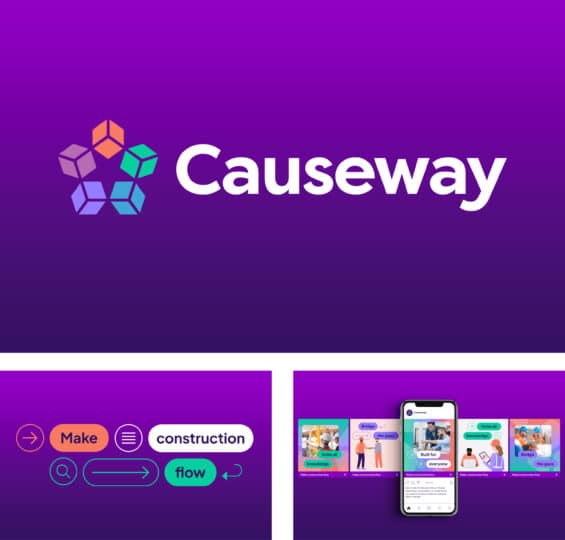
The structure provided a common language that united diverse stakeholders around a cohesive brand strategy.
How frameworks help brands scale and differentiate
As organisations grow, maintaining a consistent brand position becomes increasingly complex. New product lines, geographic expansions, and evolving market dynamics all threaten to dilute your core brand idea.
A robust brand positioning model acts as a decision-making filter that:
- Prevents unnecessary brand extensions that confuse your market position.
- Streamlines messaging across multiple channels and audiences.
- Creates a foundation for competitive differentiation that scales.
The strategic brand positioning work we conducted for the Maxa Group merger demonstrates this perfectly. By establishing a unified framework before implementation, the organisation could maintain brand coherence while integrating diverse business units.

Brand positioning within the brand strategy framework
Before diving deeper into the positioning framework itself, it’s worth understanding where positioning fits within your broader brand strategy. Think of brand strategy as the comprehensive game plan for how your brand will achieve its business objectives.
Within this plan, positioning serves as the strategic core that informs all other brand decisions.
A comprehensive brand strategy framework typically includes:
- Brand purpose: Why your organisation exists beyond profit.
- Brand vision: Where you’re heading and what you aspire to become.
- Brand positioning: Your unique place in the market (what we’re focusing on).
- Brand architecture: How your products, services, and sub-brands relate.
- Brand messaging: How you communicate your value verbally.
- Brand identity: How you express your brand visually.
Positioning is the linchpin that connects your internal purpose and vision with your external expression. Get the positioning wrong, and even the most beautiful visual identity or compelling messaging will fail to resonate with your target audience.
When working with clients like Amplius during their merger, we establish the positioning framework first, then build outward to messaging and visual identity. This sequential approach ensures all brand expressions stem from a solid strategic foundation.
The evolution of brand positioning
The concept of brand positioning has evolved significantly since Ries and Trout first popularised it in the 1980s.
Originally focused primarily on creating a distinct place in consumers’ minds relative to competitors, modern positioning frameworks now incorporate:
- Purpose-driven elements: How your positioning connects to societal needs.
- Experience dimensions: How your position manifests across customer touchpoints.
- Digital considerations: How your position translates across digital platforms.
- Cultural relevance: How your position reflects or challenges cultural norms.
These evolutions reflect the increasing sophistication of markets and consumers. Today’s most effective positioning frameworks acknowledge these dimensions while maintaining focus on the core elements that drive differentiation.

What a brand positioning framework should include
Before we share our template, here’s what any good positioning framework needs to cover. Each component plays a vital role in creating a comprehensive brand strategy that stands up to market pressures and internal scrutiny.
Your target audience and what drives them
Positioning starts with people—specifically, the people you want to reach. Vague demographic descriptions won’t suffice here.
Your framework should articulate:
- Detailed audience segmentation beyond basic demographics.
- Key motivations and pain points that drive decision-making.
- Emotional and functional needs your brand can address.
The most effective brand positioning tool is one that forces specificity. Rather than targeting “businesses looking for technology solutions,” you might focus on “mid-sized construction firms struggling with data fragmentation across project management systems.”
Your market context and competitive set
No brand exists in isolation. Your positioning framework must acknowledge the competitive landscape and where you fit within it.
This includes:
- Primary and secondary competitors
- Alternative solutions (including non-direct competition)
- Market trends that create opportunities or threats
- A positioning map that visualises where you stand in relation to others
This contextual understanding prevents the common pitfall of claiming differentiation in areas where multiple competitors are already established. For instance, in the fintech space, “user-friendly interface” is table stakes, not a brand positioning tool for differentiation.
Your brand’s unique value proposition
At the heart of any brand positioning strategy framework is your unique value proposition—what you deliver that others don’t. This should be:
- Genuinely distinctive (not just marketing spin)
- Relevant to your audience’s needs and wants
- Defensible against competitive responses
- Sustainable as markets evolve
For Amplius, developing this proposition required balancing technical expertise with emotional resonance. The resulting brand essence captured both elements, creating a positioning that competitors couldn’t easily replicate.
Your brand’s tone, personality, and archetype
How you deliver your message is often as important as what you say. Your framework should define:
- The brand archetype that best represents your organisation
- Key personality traits that influence communications
- Tone of voice principles that guide content creation
- Visual and verbal cues that reinforce your position
These elements create consistency across touchpoints and help audiences connect with your brand on a deeper level. Whether you position as the sage offering expertise or the creator driving innovation, your archetype shapes how people perceive and relate to your brand.
Your proof points and reasons to believe
Claims without evidence quickly fall flat. A comprehensive brand positioning model includes concrete proof points that substantiate your position:
- Quantifiable results or outcomes
- Testimonials and case studies
- Proprietary processes or technologies
- Credentials, certifications, or expertise
These reasons to believe transform abstract positioning into tangible value, helping potential customers understand exactly why your claims matter in real-world applications.

The ultimate brand positioning framework [template]
Based on our experience developing strategic positioning for organisations across sectors, we’ve created this practical brand positioning framework. Use it to guide internal discussions, brief agencies, or evaluate your current market position.
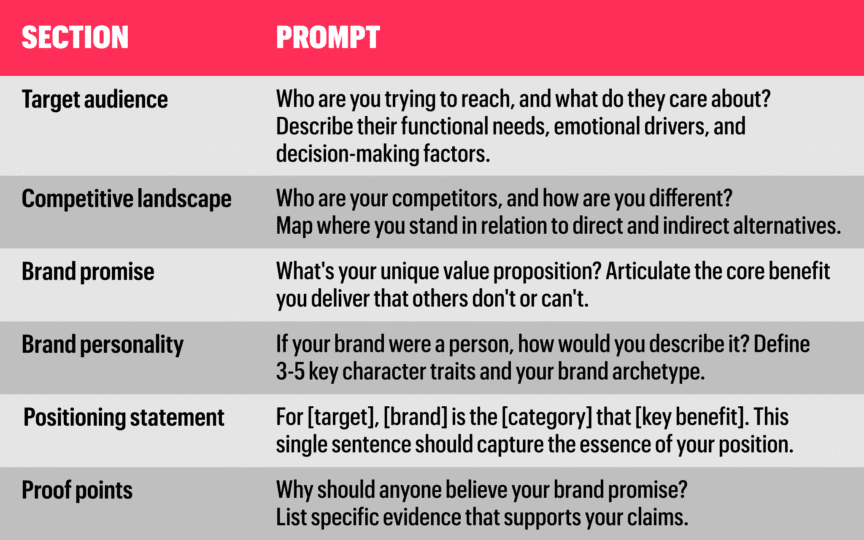
This template serves as a brand compass, guiding decisions across all aspects of your business. Teams can refer to it when creating campaign messaging, developing new products, or evaluating partnerships. It’s a living document that should evolve as your organisation grows and markets change.
From framework to implementation
Having a well-crafted brand positioning template is just the beginning. The true value emerges when it’s consistently applied across your organisation. Consider creating these supporting tools to enhance implementation:
- Positioning one-pager: A condensed version that can be easily shared with new team members and partners.
- Competitive positioning matrix: A visual comparison of how your positioning stands against key competitors.
- Message architecture: A hierarchical structure showing how your positioning translates into specific messages for different audiences and channels.
- Brand vocabulary: A list of words and phrases that reinforce your positioning, along with terms to avoid.
These supplementary brand positioning tools help translate the strategic framework into everyday operational guidance. They bridge the gap between high-level strategy and tactical execution, ensuring consistency across touchpoints.

How to use this framework effectively
A framework is only as valuable as its implementation. Here’s how to create a brand positioning framework that transforms this model into meaningful market differentiation.
Use it to build alignment across teams
One of the greatest challenges in brand strategy is ensuring consistent understanding across departments. Your framework should:
- Serve as a reference point for marketing, sales, product, and leadership
- Create a shared language for discussing brand decisions
- Reduce subjective interpretations of what the brand stands for
- Streamline briefing processes for agencies and new team members
When everyone operates from the same brand positioning canvas, the result is greater coherence in how your organisation presents itself to the world.
Pressure-test your positioning against competitors
A positioning statement that sounds distinctive in the boardroom may collapse when exposed to market realities. Before finalising your framework:
- Conduct competitor analysis to identify potential overlap
- Gather customer feedback on your proposed positioning
- Role-play competitor responses to your claims
- Evaluate whether your position is defensible over time
This rigorous testing strengthens your framework and prevents costly repositioning efforts later. For instance, claiming “industry-leading customer service” requires proof points that truly set you apart from competitors making similar claims.
Revisit it when expanding, merging or launching
Brand positioning isn’t a one-time exercise. Your framework should be revisited at key organisational milestones:
- When entering new markets or segments
- During mergers and acquisitions
- Before major product launches or pivots
- In response to significant competitor repositioning
These inflection points present both risks and opportunities for your brand position. Having a structured framework makes adaptation more strategic and less reactive.
Creating a brand positioning statement
The positioning statement is perhaps the most concentrated expression of your brand strategy—a single sentence that captures who you serve, what you offer, and why it matters. This seemingly simple formula requires precision:
For [target audience], [brand name] is the [category] that [key benefit/differentiator].
Let’s unpack each component in this brand positioning strategy framework:
- Target audience: Be specific about who you’re speaking to
- Brand name: Your organisation or product identifier
- Category: The space in which you compete
- Key benefit: The primary value you deliver that others don’t
A strong positioning statement provides immediate clarity about your brand’s focus. For example: “For construction professionals struggling with project data fragmentation, Causeway is the integrated technology platform that unifies information across the entire project lifecycle.”
This statement becomes the cornerstone of your brand messaging hierarchy, informing everything from taglines to feature descriptions.

Common positioning pitfalls to avoid
Even with a solid framework, certain mistakes can undermine your brand positioning efforts:
- Claiming non-distinctive benefits: If everyone in your category can make the same claim, it’s not positioning.
- Positioning too broadly: Trying to be all things to all people dilutes your brand impact.
- Ignoring market perception: Your positioning must acknowledge your current market position, not just your aspirations.
- Missing emotional connection: Even B2B brands need emotional resonance alongside functional benefits.
- Failing to evolve: Markets change, competitors adapt, and positioning that worked yesterday may not work tomorrow.
By avoiding these common traps, your positioning framework becomes a dynamic tool that evolves with your organisation rather than constraining it.
The tactical implementation challenge
Perhaps the most common positioning failure isn’t in the framework itself, but in its implementation. Many organisations invest significant resources in developing a positioning strategy, only to falter when bringing it to life. Implementation challenges typically occur for several reasons:
- Lack of internal alignment: When key stakeholders haven’t bought into the positioning, execution becomes inconsistent.
- Insufficient resources: Positioning shifts often require investment in new marketing materials, training, and sometimes product adjustments.
- Impatience: Positioning changes take time to resonate with markets; many organisations abandon ship too early.
- Measurement gaps: Without clear KPIs for your positioning efforts, it’s difficult to gauge success or make adjustments.
Successful organisations approach positioning as a long-term strategic initiative, not a quick-fix marketing project. They create detailed implementation roadmaps that span departments, channels, and customer touchpoints.
Most importantly, they establish metrics that track not just awareness, but the degree to which customers understand and value their distinct position.
Testing your positioning before launch
Before fully committing to a new positioning framework, it’s advisable to test it with various stakeholders:
- Internal teams: Do employees understand and believe in the positioning? Can they articulate it clearly?
- Existing customers: Does the positioning resonate with your current base without alienating them?
- Prospective customers: Does it create interest and relevance among those you hope to attract?
- Market analysts: How does your positioning compare to competitive analysis from industry experts?
These testing phases can reveal blind spots in your positioning before you invest heavily in implementation. For instance, what seems differentiated internally might be perceived as commonplace by customers who have heard similar claims from competitors.
Brand positioning examples that work
Effective positioning creates a clear space in customers’ minds.
Consider these examples:
- Volvo: For safety-conscious drivers, Volvo is the automotive brand that prioritises passenger protection above all else.
- MailChimp: For small businesses without dedicated marketing teams, MailChimp is the marketing platform that makes sophisticated campaigns simple.
- Patagonia: For environmentally conscious outdoor enthusiasts, Patagonia is the apparel brand that balances performance with planet-friendly practices.
These brands don’t try to be everything to everyone. Instead, they occupy a specific territory in the market and own it completely, demonstrating how focused positioning leads to market recognition.
Sector-specific positioning approaches
While the fundamental principles of brand positioning remain consistent across industries, certain sectors benefit from tailored approaches:
Technology & SaaS
Technology companies often face the challenge of positioning complex products in terms of customer outcomes rather than features.
Effective technology positioning frameworks typically emphasise:
- Problem-solution narratives that highlight customer pain points.
- Concrete ROI metrics and efficiency gains.
- Integration capabilities with existing systems.
- User experience and accessibility advantages.
For example, when we worked with Causeway Technologies, we shifted their positioning from technical capability to business outcome, focusing on how their solutions unified fragmented project data to deliver measurable efficiency improvements.
Professional services
Service-based businesses face unique positioning challenges, as their offerings are often intangible and difficult to differentiate.
Successful positioning in this sector tends to leverage:
- Specialisation in specific industries or problems.
- Proprietary methodologies or approaches.
- Thought leadership and expertise markers.
- Client relationship models and service experience.
The brand positioning canvas for professional services must balance credibility signals with emotional connection points that build trust between provider and client.
Consumer goods
In consumer markets, emotional and lifestyle elements often drive positioning more than functional benefits.
Effective consumer brand positioning frequently incorporates:
- Aspirational identity elements that consumers want to embody.
- Community building around shared values.
- Origin stories that create authenticity.
- Price-value relationship clarity.
These sector-specific approaches demonstrate how the basic positioning framework can be adapted to different market contexts while maintaining its core structure and purpose.

A final word from Fabrik
Frameworks don’t build brands—but they give you the structure to do it better.
The best positioning doesn’t feel like positioning at all; it feels like a natural expression of who you are and why you matter to your customers. It creates the foundation for authentic connections that transcend features and benefits.
If you’re staring down the barrel of a repositioning project or struggling to distil your value into a sentence that lands—give this brand positioning framework a try. Use it to challenge assumptions, align teams, and create a brand position that truly differentiates.
Or if you’re looking for a comprehensive brand positioning guide, our professional brand positioning services are designed to help you navigate this crucial strategic work.
Remember: in a world of endless options, brands that stand for something specific stand out. Your positioning framework isn’t just a strategic exercise—it’s your path to meaningful market differentiation.
Fabrik: A branding agency for our times.

Clarity starts with a conversation.
Thanks—we’ll get back to you shortly.
Whether you're navigating a rebrand, merger, or simply need a clearer identity—we’re here to help. No hard sell, just honest advice from people who know the sector.
Let’s start with a simple question…
Prefer to email? Drop us a line.
Fabrik’s been helping organisations rethink and reshape their brands for over 25 years. We’ve guided companies through mergers, rebrands and new launches. Whatever stage you’re at, we’ll meet you there.
