







Brand differentiation vs. brand positioning – what’s the difference?

In today’s competitive marketplace, creating a distinctive brand that resonates with consumers requires strategic thinking and precise execution. Two fundamental concepts often discussed in branding circles are brand differentiation and brand positioning.
While these terms are sometimes used interchangeably, they represent distinct strategies that serve different purposes in your overall brand development.
Understanding the nuances between brand differentiation and brand positioning isn’t merely an academic exercise—it’s essential knowledge for brand managers, marketing directors, and business leaders seeking to establish meaningful connections with their target audiences.
This article explores the key differences between these concepts, illustrates how they work together, and provides practical insights on implementing both strategies effectively.
Whether you’re developing a new brand or refining an existing one, grasping the relationship between differentiation and positioning will help you create a more coherent, compelling brand strategy that drives business growth.
Understanding brand differentiation
Brand differentiation refers to the process of distinguishing your brand from competitors by emphasising unique attributes, features, or benefits that make your offerings stand out in the marketplace.
It answers the fundamental question: “How is our brand different from others?”
Effective brand differentiation creates a clear separation between your offering and those of your competitors, helping consumers understand why they should choose your brand over alternatives.
In increasingly saturated markets, differentiation has become crucial for survival and growth.
Differentiation can be achieved through various elements:
- Product features and functionality: Unique capabilities or design elements that competitors don’t offer.
- Quality and performance: Superior craftsmanship or results compared to alternatives.
- Service delivery: Exceptional customer service or unique service models.
- Innovation: Groundbreaking approaches or technologies.
- Heritage and story: A compelling brand narrative that creates emotional resonance.
- Visual identity: Distinctive design elements that create immediate recognition.
The goal of brand differentiation is to make your offering the obvious choice by highlighting what makes it unique.
Without clear differentiation, brands risk becoming indistinguishable commodities, forcing them to compete primarily on price—a precarious position in today’s value-driven marketplace.
Real-world example: Sight Scotland
The rebranding of Royal Blind and Scottish War Blinded to Sight Scotland and Sight Scotland Veterans provides an excellent illustration of effective brand differentiation.
How differentiation shaped their brand
In a sector with numerous vision-related charities, Sight Scotland needed to establish a distinctive presence while maintaining its heritage and credibility.
Their differentiation strategy focused on creating a bold, accessible visual identity system that would stand out in the nonprofit landscape.
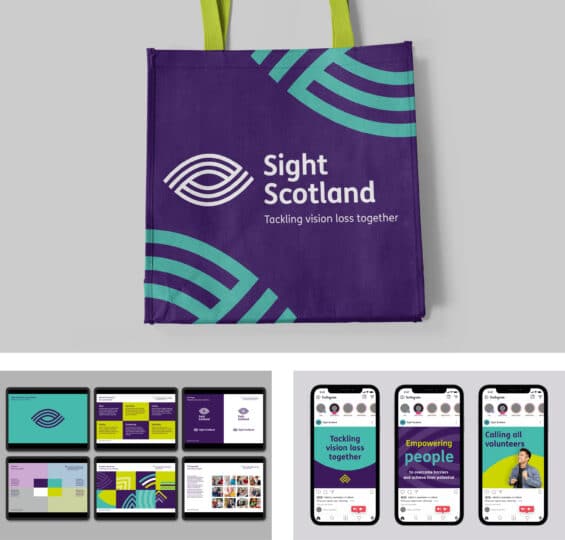
The organisation developed a distinctive visual language featuring a vibrant colour palette and clear, accessible design elements.
This visual differentiation was complemented by straightforward, impactful messaging that communicated their unique approach to supporting people with visual impairments.
What makes this example particularly effective is how the differentiation elements aligned perfectly with the organisation’s purpose and audience needs.
The vibrant colours and accessible design weren’t merely aesthetic choices—they reflected the charity’s commitment to inclusivity and visibility.
Sight Scotland’s rebranding journey demonstrates how thoughtful differentiation can help an organisation stand out while authentically representing its values and mission.

What is brand positioning?
While differentiation focuses on highlighting unique attributes, brand positioning is about occupying a specific, valued place in the consumer’s mind relative to competing offerings. Positioning defines where your brand sits in the market landscape and how you want consumers to perceive it compared to alternatives.
Brand positioning addresses the question: “What space do we want to own in our customers’ minds?” It’s about creating a perception that gives your brand a distinct, desirable place in the market and in consumers’ thinking.
Effective positioning requires:
- Market understanding: Deep knowledge of competitive offerings and market gaps.
- Customer insight: Clear understanding of target audience needs, desires, and perceptions.
- Strategic intent: Deliberate decisions about which market segments and value propositions to prioritise.
- Focus and consistency: Maintaining a coherent position across all brand touchpoints.
Unlike differentiation, which can encompass numerous unique attributes, positioning typically focuses on a few key dimensions that matter most to target customers.
Successful positioning creates mental shortcuts that help consumers categorise and understand your brand’s place in the market.
The concept of positioning was popularised by Al Ries and Jack Trout, who emphasised that positioning happens in the mind of the customer, not in marketing materials.
Your brand position exists whether you actively manage it or not, making strategic positioning an essential element of brand management.
Real-world example: MinervaX
MinervaX, a biotechnology company developing vaccines against Group B Streptococcus (GBS), offers an excellent case study in strategic brand positioning.
Strategic brand positioning in a competitive market
Operating in the complex and crowded pharmaceutical sector, MinervaX needed to position itself distinctively to attract investment, research partners, and eventually, healthcare providers.
Rather than attempting to compete directly with established pharmaceutical giants, MinervaX positioned itself as a specialised innovator focused exclusively on addressing a specific unmet medical need.

This focused positioning allowed MinervaX to occupy a clear, distinctive space in the minds of stakeholders. By positioning as specialists rather than generalists, they created a compelling narrative about their expertise and dedication to solving a specific health challenge.
The company’s strategic brand positioning (by Fabrik) was reflected across all touchpoints, from their visual identity to communication materials, creating a consistent impression of focused expertise and innovation.
This positioning helped them stand out in a market dominated by much larger competitors.

Key differences between brand differentiation and brand positioning
Understanding the distinctions between brand differentiation and brand positioning is essential for developing effective brand strategies.
While they work in tandem, they serve different purposes and require different approaches:
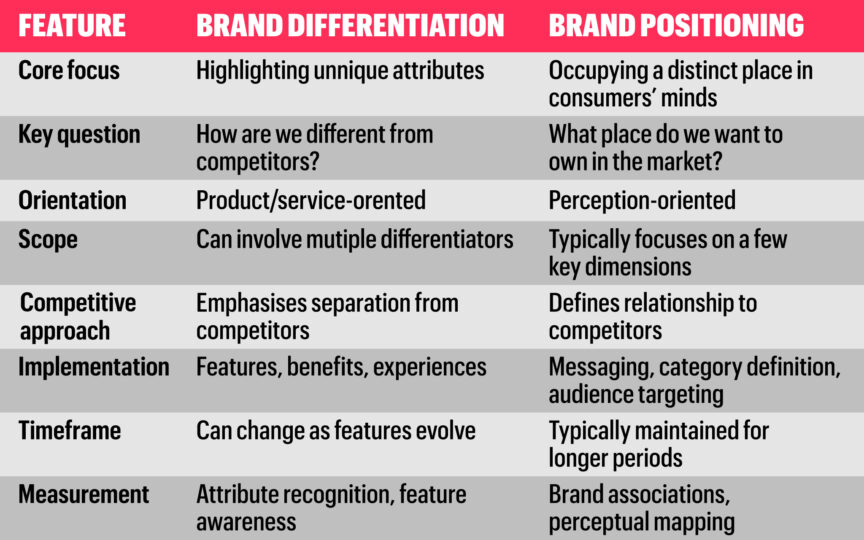
Differentiation often serves as the foundation for positioning, providing the unique elements that enable a brand to claim a specific position. However, positioning goes beyond listing differences to establish a strategic place in the competitive landscape.
A helpful analogy is to think of differentiation as the features on a map (mountains, rivers, forests) and positioning as the specific coordinates where you want to be located. Both are essential for navigation, but they serve different purposes.
Practical examples of how they work together
When differentiation and positioning work in harmony, they create powerful brand impressions.
Consider these examples:
Apple: Apple differentiates through innovative design, intuitive interfaces, and ecosystem integration. These differentiators support its positioning as a premium, design-focused technology brand that makes complex technology accessible and enjoyable.
Patagonia: This outdoor clothing company differentiates through environmental activism, transparent supply chains, and durable products. These elements support its positioning as an environmentally responsible alternative to conventional outdoor brands.
Innocent Drinks: The brand differentiates through natural ingredients, playful packaging, and conversational tone. These attributes support its positioning as a healthier, more personable alternative to traditional beverage options.
In each case, the differentiation elements serve the positioning strategy, creating a coherent brand impression that occupies a distinct space in consumers’ minds.

When to focus on differentiation vs. positioning
While both differentiation and positioning are essential to brand strategy, certain business situations may call for greater emphasis on one or the other:
Focus more on differentiation when:
- Launching a truly innovative product or service.
- Operating in a market with highly similar offerings.
- Facing commoditisation pressures.
- Undergoing significant product or service improvements.
- Responding to competitive imitation of previous differentiators.
Focus more on positioning when:
- Entering a new market or category.
- Repositioning following a merger or acquisition.
- Facing changing customer perceptions.
- Experiencing brand confusion or dilution.
- Addressing increased competitive pressure in your market position.
The ideal approach usually involves developing both strategies in parallel, ensuring they support and reinforce each other. However, limited resources may necessitate prioritising one aspect temporarily while building toward a more comprehensive strategy.
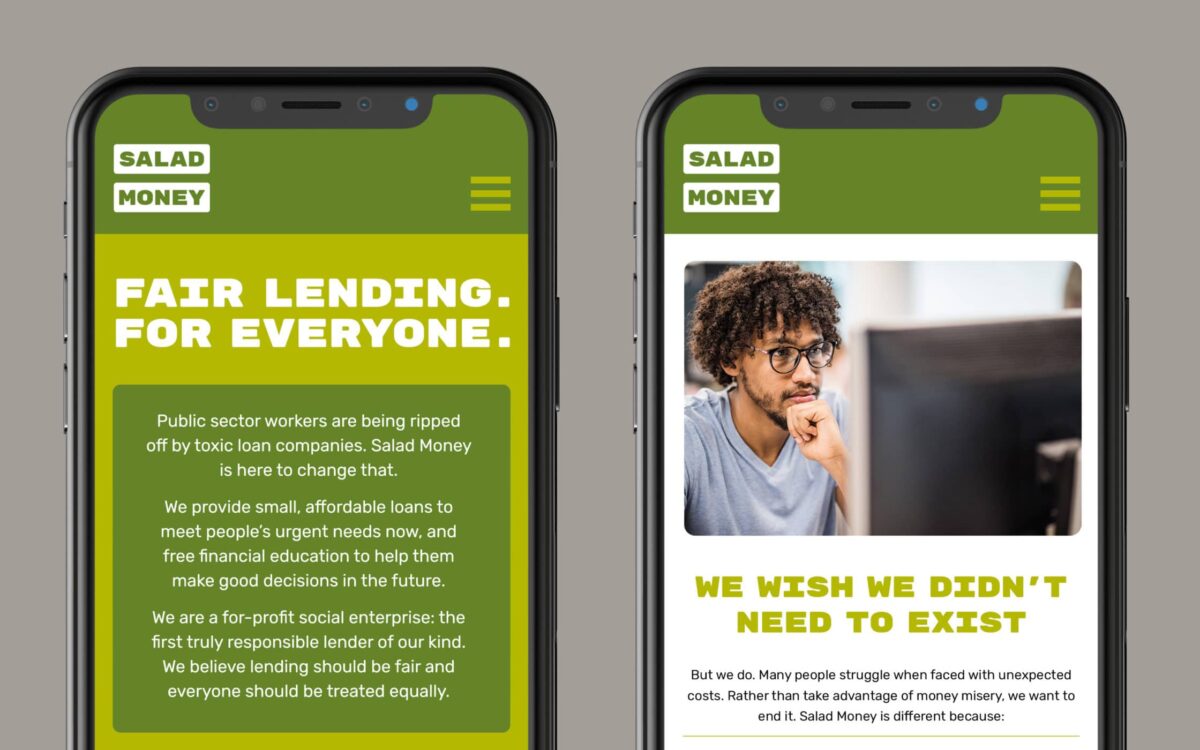
Case study: Salad Money
Salad Money provides a compelling example of using positioning to create a distinct niche in a crowded market.
Operating in the financial services sector—an industry with numerous lending options—Salad Money needed a clear positioning strategy to establish its unique place in the market.
Using positioning to carve out a niche
Rather than competing directly with mainstream lenders, Salad Money positioned itself as a socially responsible alternative specifically for NHS and public sector workers.
This positioning was based on deep customer insights about the financial challenges faced by these workers and gaps in traditional lending services.
By positioning as specialists in serving a specific audience segment with distinct needs, Salad Money created a clear alternative to generic lenders.
Their positioning strategy (created by Fabrik) informed everything from their product development to communication approach, creating a coherent brand experience that resonated with their target audience.
This case demonstrates how effective positioning can help even smaller brands compete successfully by occupying a distinct, meaningful space in consumers’ minds rather than attempting to challenge larger competitors directly.

Practical tips for balancing differentiation and positioning
Creating a powerful brand requires thoughtful integration of both differentiation and positioning strategies.
Here are practical approaches for developing and balancing these elements effectively:
1. Start with customer insights
Meaningful differentiation and positioning must be grounded in deep understanding of customer needs, desires, and perceptions. Invest in qualitative and quantitative research to identify what matters most to your target audience and where gaps exist in the current market offerings.
2. Map the competitive landscape
Create a detailed analysis of competitor positioning and differentiators to identify white space opportunities. Visual mapping exercises can help identify where potential positions exist that align with both customer needs and your brand capabilities.
3. Identify your sustainable differentiators
Focus on differences that are difficult for competitors to imitate and that you can maintain consistently over time. Sustainable differentiation typically comes from organisational capabilities, values, and processes rather than easily copied features.
4. Define your positioning in clear language
Develop a concise positioning statement that articulates your target audience, frame of reference, point of difference, and reason to believe. This statement serves as an internal compass for maintaining consistent positioning across all brand touchpoints.
5. Test both elements with target customers
Validate that your differentiators are meaningful and that your intended positioning is both credible and compelling. Adjust your approach based on customer feedback rather than internal assumptions.
6. Create alignment across the organisation
Ensure everyone understands both your differentiators and your positioning strategy. True brand coherence requires consistent implementation across all customer touchpoints, which depends on organisational alignment.
7. Monitor performance and evolve strategically
Regularly assess whether your differentiation remains distinctive, and your positioning remains relevant. Market dynamics change constantly, requiring ongoing refinement of both strategies.

Case study: Causeway
Causeway exemplifies how effective integration of differentiation and positioning can create a compelling brand presence. As a technology provider in the built environment sector, Causeway needed to establish a distinctive presence in a competitive landscape.
Combining differentiation and positioning effectively
Fabrik approached the Causeway rebrand by with identifying meaningful differentiators—including their specialised industry expertise, integrated platform approach, and focus on practical innovation.
These differentiators provided the foundation for their positioning as strategic technology partners rather than merely software vendors.
The brand strategy carefully balanced highlighting Causeway’s unique capabilities while establishing a clear position relative to both traditional competitors and emerging technology providers.
This integrated approach created coherence across all brand elements, from their visual identity to their messaging framework.
What makes this case particularly instructive is how the differentiation and positioning strategies reinforced each other, creating a distinctive market presence that resonated with their target audience of construction and infrastructure professionals.

Common mistakes to avoid
When developing differentiation and positioning strategies, several common pitfalls can undermine effectiveness:
Claiming non-distinctive differentiators
Many brands claim differentiators that are actually category requirements or table stakes. True differentiation must involve elements that are genuinely unique or delivered in distinctively superior ways compared to competitors.
Positioning too broadly
Attempting to appeal to everyone typically results in positioning that resonates with no one. Effective positioning requires making strategic choices about which audience segments and value dimensions to prioritise.
Disconnecting differentiation from positioning
When differentiation elements don’t support the intended positioning, brands send mixed signals that confuse customers. Every differentiator should contribute to the overall position you want to occupy.
Focusing on internal perspectives rather than customer perceptions
Both differentiation and positioning exist in customers’ minds, not in internal strategy documents. Strategies that don’t account for actual customer perceptions rarely succeed.
Changing position too frequently
While differentiators may evolve with market conditions and product development, positioning should remain relatively consistent to build long-term mental associations. Frequent repositioning creates brand confusion.
Failing to deliver on promises
Perhaps the most damaging mistake is claiming differentiators or positions that aren’t supported by actual customer experiences. Authentic differentiation and positioning must be reflected in every aspect of the customer journey.

Bringing it all together
The relationship between brand differentiation and brand positioning illustrates the sophistication required in modern brand strategy.
While differentiation establishes what makes your brand unique, positioning determines how those unique elements are framed to occupy a specific place in consumers’ minds.
Effective brand strategy requires thoughtful development of both elements, ensuring they work together to create coherent, compelling impressions.
In increasingly competitive markets, brands that successfully integrate differentiation and positioning gain significant advantages—they become more memorable, more relevant, and ultimately more valuable.
As you develop or refine your brand strategy, remember that differentiation and positioning aren’t academic exercises but practical tools for creating meaningful connections with customers.
When properly implemented, they transform functional offerings into resonant brand experiences that drive sustainable business success.
For organisations seeking to develop more effective brand differentiation and positioning strategies, Fabrik’s professional brand positioning services provide expert guidance and implementation support.
Our strategic approach combines market insights, creative excellence, and practical implementation to help brands achieve distinctive presence in competitive markets.
Fabrik: A branding agency for our times.

Clarity starts with a conversation.
Thanks—we’ll get back to you shortly.
Whether you're navigating a rebrand, merger, or simply need a clearer identity—we’re here to help. No hard sell, just honest advice from people who know the sector.
Let’s start with a simple question…
Prefer to email? Drop us a line.
Fabrik’s been helping organisations rethink and reshape their brands for over 25 years. We’ve guided companies through mergers, rebrands and new launches. Whatever stage you’re at, we’ll meet you there.
