








What are brand guidelines—and why do they matter more than ever?

In today’s fragmented digital landscape, brands face an unprecedented challenge: maintaining coherence across dozens of touchpoints while empowering teams to move quickly. Without clear direction, your brand becomes a game of Chinese whispers—distorting with every handover. Brand guidelines are the solution to this chaos, providing the essential framework that keeps your identity intact as it travels through your organisation and beyond.
The stakes are particularly high for growing businesses. As you expand into new markets, launch new products, or bring on additional team members, the risk of brand dilution increases exponentially.
Each decision point becomes an opportunity for your carefully crafted identity to erode—unless you’ve established clear parameters for everyone to follow.
What are brand guidelines?
A definition that means something
Brand guidelines (sometimes called a brand book, style guide or brand manual) are the comprehensive documentation that defines how all your brand assets look, speak and behave across all applications.
But they’re much more than a collection of logos and colour codes.
Effective brand guidelines serve as a central nervous system for your organisation—translating abstract brand strategy into practical, day-to-day direction that anyone can understand and apply.
At their best, brand guidelines democratise brand knowledge, removing the ambiguity that leads to inconsistency.
They transform your brand from something understood by a select few into a shared language that empowers everyone from your social media manager to your CEO to represent your company authentically.
Who uses brand guidelines (and why)?
Brand guidelines serve diverse teams with different needs:
For designers and creative teams, they provide clear parameters that accelerate production while maintaining quality.
For marketers and communications professionals, they ensure campaigns align with your core identity.
For HR and internal comms teams, they help translate your external brand into meaningful employee experiences.
And for external partners—from agencies to freelancers—they offer the essential context and access to all necessary brand assets needed to hit the ground running.
The fundamental value is consistency at scale.
Guidelines prevent the subtle drift that occurs when brand decisions rely on individual interpretation rather than shared standards. They’re the difference between a brand that feels cohesive across touchpoints and one that feels disjointed and amateur.
Consider the onboarding experience for new team members.
Without guidelines, each newcomer must piece together your brand through observation and trial-and-error—a process that takes months and inevitably leads to inconsistencies.
With comprehensive guidelines, that same employee can become a competent brand ambassador within days, understanding not just what your brand looks like, but why certain elements matter and how they should be applied.

Why brand guidelines matter more than ever
The landscape of brand management has transformed dramatically in recent years, making robust guidelines more critical than ever:
Remote and hybrid work has scattered teams across geographies and time zones, removing the informal brand knowledge transfer that once happened naturally in shared spaces.
Without clear documentation, remote employees create their own interpretations of your brand—often with wildly divergent results.
AI-generated content is now mainstream, with tools creating everything from social posts to product descriptions. Without clear brand parameters to guide these systems, the output quickly veers off-brand.
Strong guidelines provide the inputs that keep AI-assisted content aligned with your identity.
The proliferation of channels continues unabated. Your brand now lives across dozens of platforms, each with unique constraints and opportunities.
Guidelines must provide flexible direction that works across traditional media, social channels, voice interfaces, VR experiences and whatever comes next.
Meanwhile, the line between external and internal branding has blurred significantly. Today’s employees expect the same level of brand quality in their internal experiences as customers receive externally.
Comprehensive guidelines help maintain this consistency across all stakeholders.
For organisations experiencing rapid growth, acquisitions or rebrands, guidelines become even more crucial. They’re the infrastructure that helps new teams integrate quickly, aligning diverse workforces around a single brand vision without constant oversight.
The pace of media evolution has also accelerated dramatically. When a new platform emerges—whether it’s a social media channel, an augmented reality experience, or an AI interface—brands without clear guidelines struggle to adapt quickly.
Their response either comes too late (missing the opportunity) or appears disconnected from their core identity (damaging brand equity). Well-constructed guidelines provide the flexible foundation to expand into new channels without starting from scratch each time.
All these factors make brand guidelines the indispensable central operating system for modern brand management—not a nice-to-have document, but essential infrastructure.
What should brand guidelines include?
While no two brand guideline documents are identical, most comprehensive guides cover three core areas:
Visual identity
The visual components form the most immediately recognisable part of your brand guidelines:
- Logo usage: Size requirements, clear space rules, placement guidelines, and variations for different applications and backgrounds.
- Colour palette: Primary and secondary colours with precise values (HEX, RGB, CMYK, Pantone) and guidance on usage proportions.
- Typography: Font specifications, hierarchies, sizing recommendations and licensing information.
- Imagery style: Photography direction, illustration guidelines, iconography systems and image treatment specifications.
- Layout principles: Grid systems, compositional guidance and spatial relationships that create visual consistency.
Each visual element should include both technical specifications and strategic context—explaining not just what each element is, but how it supports your broader brand positioning.
Modern visual identity guidelines also incorporate digital-specific guidance: animation principles that define how elements move, interactive behaviours that maintain consistency across digital experiences, and responsive adaptations that ensure your brand remains recognisable regardless of screen size.
These dynamic elements are increasingly important as static applications give way to motion-centric experiences.
Verbal identity
Your verbal identity is equally important but often receives less attention:
- Tone of voice: The personality and character of your communications across different contexts.
- Messaging framework: Core value propositions, positioning statements and thematic territories.
- Writing style: Grammatical preferences, punctuation choices, and formatting conventions.
- Vocabulary guidance: Language to embrace and avoid, including industry terminology preferences.
- Examples and templates: Real-world applications showing your verbal identity in action.
The verbal section should demonstrate how language shifts across different channels and audiences while maintaining a consistent underlying character.
Effective verbal guidelines don’t just dictate rules—they illustrate the thinking behind them. For instance, rather than simply stating “use an active voice,” they explain how active language reinforces your brand’s dynamic positioning.
This context transforms guidelines from arbitrary restrictions into strategic tools that help teams make informed decisions even in unprecedented situations.
Collectively, these visual and verbal elements form the core brand assets that effective guidelines meticulously define and manage.
Brand structure and usage rules
This section addresses the operational aspects of your brand:
- Brand architecture: How sub-brands, product lines or divisions relate to your master brand.
- Naming conventions: Protocols for naming new products, features or initiatives.
- Co-branding guidelines: Rules for presenting your brand alongside partners.
- Application examples: Practical demonstrations across common touchpoints.
- Brand governance processes: Who makes brand decisions and how to request guidance or exceptions.
This governance aspect proved particularly valuable in our work with MAXA Group, where we developed brand guidelines that helped unify multiple business units following a merger.
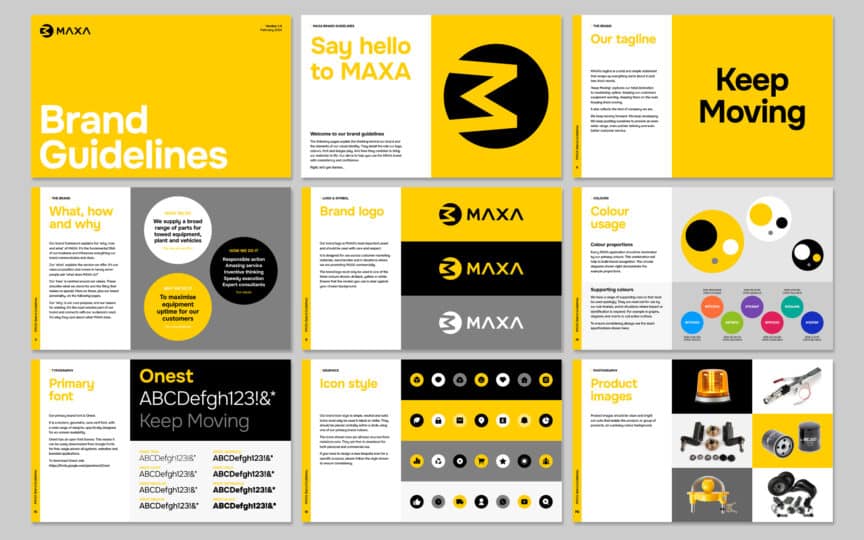
The guidelines established clear brand hierarchy and decision-making protocols that empowered teams while maintaining consistency across the enlarged organisation.
This section should also address digital-specific considerations that are increasingly critical:
- Social media expression: Platform-specific adaptations of your brand elements.
- URL structures and digital naming: Conventions for domain names, page URLs and digital product naming.
- Metadata and SEO guidance: How your brand appears in search results and digital listings.
- Accessibility requirements: Ensuring your brand remains inclusive across all platforms.
Good brand guidelines don’t just tell people what not to do—they show them how to get it right. For each restriction, provide a constructive alternative that achieves the same goal while maintaining brand integrity.

What happens when you don’t have clear brand guidelines?
Without proper guidelines, predictable chaos ensues:
- Logos appear stretched, crowded or in inappropriate colours across different materials, and consistency across all other brand assets becomes elusive.
- Brand voice swings wildly from corporate jargon to overly casual across different channels.
- Product and feature naming follows no discernible pattern, creating confusion.
- Visual quality varies dramatically between teams, creating an impression of disorganisation.
- Customer-facing staff describe your value proposition differently, undermining clarity.
- Agencies and freelancers waste billable hours guessing what you want instead of creating value.
- Internal communications feel disconnected from your external brand, undermining culture.
- Social media accounts develop distinct personalities that feel unrelated to each other.
- Digital and print experiences appear to come from entirely different companies.
- Design decisions become prolonged debates without clear resolution criteria.
The financial impact is substantial but often hidden: increased production costs from endless revisions, inflated agency fees from unnecessary clarification rounds, and reduced marketing effectiveness from disjointed campaigns.
Most damaging, however, is the opportunity cost—the strategic initiatives that never launch because teams are too busy fixing basic brand inconsistencies.
The cumulative effect is a fragmented brand experience that damages credibility, reduces efficiency, and ultimately erodes trust.
Without guidelines, your brand becomes the loudest voice in the room rather than the most consistent—a recipe for being forgotten or dismissed.
Do brand guidelines kill creativity?
Contrary to the fear that guidelines restrict creativity, well-crafted brand guidelines actually enable it.
By establishing clear boundaries and expectations, guidelines eliminate the anxiety of the blank page. They provide creative teams with a focused playground within which to innovate, rather than an intimidating universe of endless options.
Guidelines also prevent wasted effort by clarifying what’s already been decided, allowing teams to build upon established foundations rather than constantly reinventing the wheel.
They free up cognitive bandwidth to focus on solving genuine creative challenges rather than basic brand questions.
Most importantly, guidelines shift the creative focus from arbitrary personal preference (“I don’t like blue”) to strategic effectiveness (“This doesn’t align with our approachable positioning”).
This elevates creative discussions from subjective taste to meaningful brand building.
Consider how the most iconic brands leverage guidelines: Apple’s meticulous attention to detail doesn’t restrict their innovation—it enhances it by creating a recognisable foundation that makes new products feel both fresh and familiar.
Nike’s brand system allows for tremendous creative expression while maintaining instant recognisability. These brands aren’t successful despite their rigorous guidelines, but because of them.
The most successful creative organisations—from film studios to design firms—embrace constraints as catalysts for innovation, not barriers to it.
Your brand guidelines should function the same way.

Guidelines that guide, not just prescribe
The most valuable brand guidelines are living, breathing tools—not dusty PDFs buried in email attachments or intranet folders.
Modern guidelines should be accessible, updatable and genuinely embraced by your organisation. They should evolve as your brand does, incorporating new use cases and applications as they emerge.
And they should be written for humans—not just designers or marketers—using language that makes sense to everyone who touches your brand.
Format matters too. While traditional printed brand books still have ceremonial value, digital guideline platforms offer significant advantages: they can be updated instantly, accessed anywhere, and structured to serve different user needs.
A marketing director and a junior designer might need the same guidelines, but in different formats with different levels of detail. Digital systems can accommodate these varied requirements without creating multiple contradictory versions.
Implementation is equally important. Even the most brilliantly crafted guidelines are worthless without an adoption strategy.
This means training sessions, easy-to-access templates, regular reinforcement, and designated brand ambassadors who can answer questions and provide guidance.
The most effective organisations build brand governance into their workflows, making consistency the path of least resistance rather than an additional burden.
The true measure of effective brand guidelines isn’t their visual polish or the weight of the document, but the quality and consistency they produce in the wild. Guidelines are only valuable when they’re used, understood and internalised by your entire organisation.
This is where Fabrik helps—crafting brand guidelines that genuinely guide rather than merely prescribe. Our focus is creating practical tools that maintain brand integrity without stifling the people who bring your brand to life every day.
Fabrik: A branding agency for our times.

Clarity starts with a conversation.
Thanks—we’ll get back to you shortly.
Whether you're navigating a rebrand, merger, or simply need a clearer identity—we’re here to help. No hard sell, just honest advice from people who know the sector.
Let’s start with a simple question…
Prefer to email? Drop us a line.
Fabrik’s been helping organisations rethink and reshape their brands for over 25 years. We’ve guided companies through mergers, rebrands and new launches. Whatever stage you’re at, we’ll meet you there.
