










How to create a verbal identity framework your team can actually use

Most brand voice guidelines end up as beautiful PDFs gathering digital dust. You know the type—glossy documents filled with tone words and abstract principles that sound impressive in boardrooms but leave your content team scratching their heads when it’s time to write a social media post or craft an email campaign.
The problem isn’t that verbal identity doesn’t matter. It’s that most frameworks are built like manifestos, not toolkits. They’re designed to inspire rather than instruct, leaving teams with lofty ideals but no practical roadmap for bringing those ideals to life.
This article is about changing that.
We’ll show you how to create brand voice guidelines that bridge the gap between brand strategy and real-world content creation—one your team will reach for, not avoid.
Why most brand voice guidelines gather dust
Even the most thoughtfully crafted verbal identity can fail if it’s not designed for practical use. The gap between a framework that transforms your communications and one that sits unused often comes down to three key flaws.
They’re written like theory, not tools
Traditional brand voice guidelines read like academic papers. They’re packed with abstract concepts like “approachable yet authoritative” or “premium but accessible” without showing what those principles look like in practice.
Your copywriter doesn’t need to know your brand voice is “confident and innovative”—they need to see exactly how confident and innovative sounds when you’re explaining a complex product or handling a customer complaint.
Usable guidelines show rather than tell. They include before-and-after examples, sample phrases for different scenarios, and clear do’s and don’ts that remove guesswork from the writing process.
No one owns it internally
Too many verbal identity projects suffer from the “everyone and no one” problem.
The document gets developed with input from multiple stakeholders, reviewed by countless committees, and approved by senior leadership—but no single person or team feels responsible for keeping it alive and relevant.
Without a dedicated owner, your messaging toolkit becomes orphaned. Updates don’t happen, new team members don’t get trained, and inconsistencies creep in across different touchpoints. The framework loses its power to create scalable messaging.
There’s no link between voice and message
Brand tone of voice gets most of the attention, but tone without substance is just style. A truly effective framework connects how you sound with what you say, creating a clear message hierarchy that flows from your core purpose down to specific proof points and calls to action.
This connection ensures your team-friendly brand voice isn’t just consistent—it’s strategically aligned with your business objectives and customer needs.

The core components of usable brand voice guidelines
A practical verbal identity framework goes beyond defining personality traits. It creates a structured system that connects your brand strategy to every piece of content your team produces, making consistent messaging both achievable and scalable.
Voice principles with purpose
Start with three to five voice principles that feel specific to your brand and situation. Instead of generic descriptors like “friendly” or “professional,” choose principles that reflect your unique position and audience needs.
Each principle should come with clear examples and context.
If one of your principles is “refreshingly direct,” show what that means when explaining pricing, addressing concerns, or celebrating successes. Include sample phrases, sentence structures, and even words to avoid that help writers embody this principle in their work.
The key is making these principles feel like practical filters rather than abstract aspirations. Your team should be able to read any piece of content and quickly assess whether it aligns with your established voice.
Messaging hierarchy
Effective brand messaging follows a logical structure: purpose drives values, values inform key messages, and key messages get supported by specific proof points.
This hierarchy ensures every communication ladder up to your core brand strategy while remaining relevant to your audience’s immediate needs.
Start at the top with your fundamental purpose—the reason your organisation exists beyond making money. This anchors everything else and prevents your messaging from drifting into generic territory.
Your values should flow naturally from this purpose, representing the principles that guide how you fulfil your mission.
Key messages sit in the middle of this hierarchy, translating your purpose and values into specific benefits and differentiators your audience cares about.
These messages should be memorable, repeatable, and flexible enough to work across different contexts while maintaining their core meaning.
Taglines, straplines and CTAs
Your tagline creation process should connect directly to your broader messaging strategy. The best taglines distil your key messages into memorable phrases that capture both what you do and why it matters.
But don’t stop at your main tagline. Develop a family of straplines for different contexts—elevator pitches for networking events, email signatures for professional correspondence, and social media bios that work within character limits.
Each should feel connected to your core verbal identity while serving its specific purpose.
Your calls to action deserve the same strategic treatment. Instead of defaulting to generic phrases like “learn more” or “contact us,” develop CTAs that reflect your brand voice guidelines and reinforce your key messages.
A brand that’s “refreshingly direct” might use “Get straight answers” instead of “Schedule a consultation.”

Making your framework easy to adopt
Creating brilliant brand voice guidelines is only half the challenge. The other half is ensuring your team embraces them, uses them consistently, and keeps them alive through regular application and refinement.
Show, don’t just tell
Transform abstract principles into concrete tools by including extensive examples throughout your framework.
Create templates for common content types—social media posts, email newsletters, website copy, and presentation slides—that demonstrate your brand voice guidelines in action.
Develop a library of approved phrases, sentence starters, and language that writers can draw from when they’re stuck. Include both positive examples that nail your tone and negative examples that miss the mark, helping your team develop an intuitive sense of what sounds right.
Consider creating quick reference cards or digital tools that make your framework accessible during the content creation process. The easier you make it to apply your guidelines, the more likely your team is to use them consistently.
Involve the people who’ll use it
Your internal brand toolkit will only succeed if it’s designed with input from the people who’ll use it daily. Involve writers, marketers, customer service representatives, and anyone else who creates content on behalf of your brand in the development process.
Run workshops where team members practice applying your brand voice guidelines to real scenarios. Ask them to identify pain points in their current content creation process and design solutions that address these specific challenges.
Their insights will help you create a framework that solves problems rather than theoretical ones.
This collaborative approach also builds buy-in and ownership across your organisation. When team members help shape the framework, they’re more likely to champion its adoption and help refine it over time.
Bake it into your workflow
Integration beats education every time. Instead of hoping your team will remember to consult your guidelines, build them into your existing content creation and approval processes.
Create checklists that editors can use during review processes, ensuring every piece of content gets evaluated against your brand voice guidelines and messaging hierarchy.
Incorporate your framework into onboarding materials for new team members, making verbal identity training a standard part of joining your organisation.
Use your brand messaging as the foundation for content planning tools and editorial calendars. When your framework becomes part of how work gets done rather than an additional step to remember, consistency becomes automatic rather than effortful.

Real-world examples: Brand voice guidelines in action
Seeing how other organisations have successfully implemented usable frameworks can help you understand what effective application looks like.
Here are three examples from our work that demonstrate different approaches to creating practical, team-friendly brand storytelling structure.
MAXA Group
When multiple companies merge, creating unified messaging becomes essential for both internal alignment and external credibility.
MAXA Group’s merger required a framework that could help formerly separate teams speak with one voice while preserving the entrepreneurial spirit that made each company successful.
We developed messaging principles that emphasised collaborative expertise and ambitious thinking, supported by specific language guidelines that helped teams navigate everything from client presentations to internal communications.

The framework included practical tools like email templates and presentation structures that made the new voice feel natural rather than imposed.
The result was a seamless transition that reinforced Maxa Group’s position as a unified force in their market, with consistent messaging that felt authentic to their combined culture and compelling to their clients.
Touching Distance
Sometimes the challenge isn’t creating consistency but ensuring your unique voice translates effectively across different audiences and contexts.
Touching Distance’s branding project required a framework that could capture their innovative approach to bringing people together while remaining accessible.
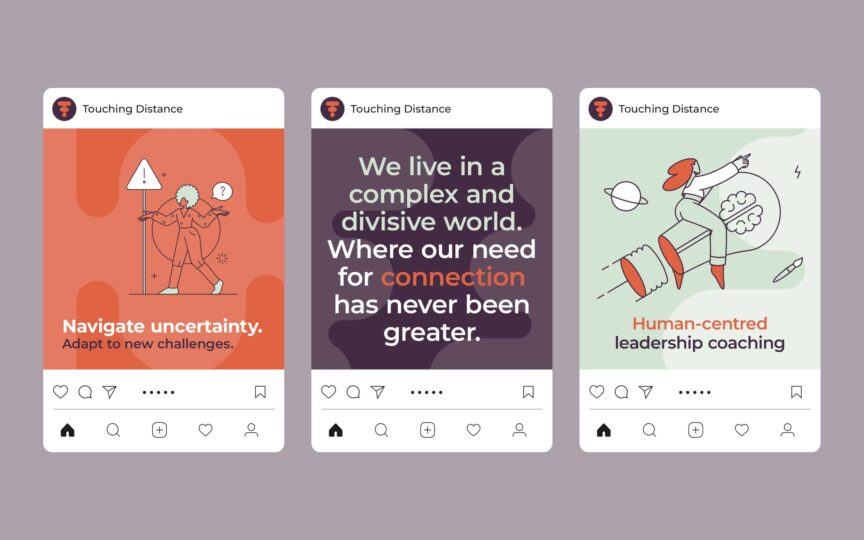
We created a brand storytelling structure that helped them articulate their purpose across everything from the company website to outreach materials.
The framework included specific guidance on balancing expertise with human impact, ensuring their communications felt both credible and inspiring.
This structured approach to voice and messaging helped Touching Distance communicate their vision with clarity and conviction, building stronger relationships with partners, investors, and the communities they serve.
Causeway
Professional services firms often struggle with verbal identity because they need to sound both authoritative and approachable across multiple touchpoints and client types.
Causeway’s brand strategy and messaging project created a comprehensive playbook that addressed this challenge head-on.
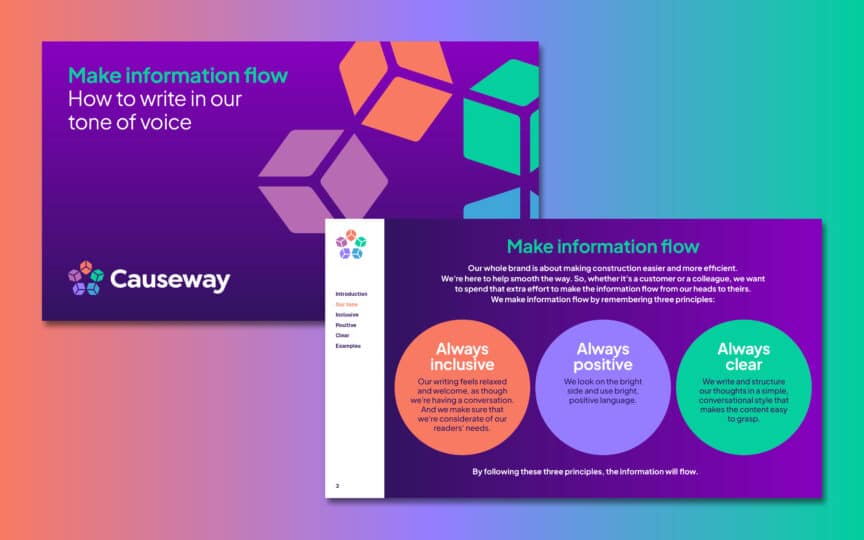
We developed a messaging toolkit that translated their core values into specific language choices for different contexts—from technical proposals to thought leadership content.
The framework included guidelines for adjusting tone based on audience seniority and subject complexity while maintaining their core voice characteristics.
This systematic approach enabled Causeway to maintain consistent messaging across their entire organisation while giving individual team members the flexibility to adapt their communications for maximum impact with specific audiences.

Build it. Use it. Own it.
Your verbal identity framework should feel like a trusted advisor, not a rigid rulebook. The best frameworks evolve with your organisation, growing more sophisticated and nuanced as your team becomes more confident in applying its principles.
Start with the basics—clear brand voice guidelines, structured messaging, and practical examples—then refine and expand based on real-world application.
Pay attention to where your team struggles or where inconsistencies emerge, and use these insights to strengthen your framework over time.
Remember that consistent messaging isn’t about sounding robotic or limiting creativity. It’s about ensuring every communication reinforces your brand’s unique value and personality, making your organisation easier to understand, faster to write for, and harder to forget.
The most powerful brand voice guidelines aren’t the ones that win design awards—they’re the ones that get used every day, transforming how your team communicates and how your audience experiences your brand.
Ready to create brand voice guidelines that your team will love using? Get in touch with Fabrik and let’s build a verbal identity framework that transforms how your organisation communicates.

Clarity starts with a conversation.
Thanks—we’ll get back to you shortly.
Whether you're navigating a rebrand, merger, or simply need a clearer identity—we’re here to help. No hard sell, just honest advice from people who know the sector.
Let’s start with a simple question…
Prefer to email? Drop us a line.
Fabrik’s been helping organisations rethink and reshape their brands for over 25 years. We’ve guided companies through mergers, rebrands and new launches. Whatever stage you’re at, we’ll meet you there.
