








What’s the purpose of brand purpose? Make it clear, make it work

A plain-English guide to what brand purpose is, how to write it, and how to make it real.
Brand purpose has become the business world’s answer to everything—from attracting talent to driving growth, from weathering crises to winning customer loyalty. Yet for all the evangelical fervour around purpose-driven brands, many organisations struggle to move beyond worthy-sounding statements that gather dust in boardrooms.
The difference between purpose that works and purpose that doesn’t isn’t philosophical—it’s practical. Real brand purpose guides decisions, shapes behaviour, and creates measurable change.
Everything else is just expensive wallpaper.
Brand purpose explained
Brand purpose isn’t a marketing fad that arrived with millennials and oat milk lattes. It’s an organisational truth that savvy brands have always understood: people want to buy from, work for, and champion companies that stand for something meaningful beyond profit.
What’s changed isn’t the concept—it’s the urgency. In an era of infinite choice and instant information, brand purpose has shifted from nice-to-have to business-critical. Today’s twist on purpose cuts through the rhetoric to demand relevance and proof.
Consumers can spot purpose-washing from orbit, and they’re not impressed by grand statements without matching actions.
What brand purpose is (and isn’t)
Brand purpose is your organisation’s reason to exist beyond making money—the positive change you’re uniquely positioned to create in the world. It’s the lens through which you make trade-offs, allocate resources, and measure success.
Brand purpose isn’t a tagline you stick on adverts, a generic commitment to “making the world a better place,” or a CSR initiative you bolt onto existing operations. It’s not your mission statement in disguise, nor is it a marketing campaign masquerading as corporate strategy.
Authentic brand purpose lives at the intersection of what the world needs, what you’re brilliant at, and what you can credibly deliver.
Everything else is just noise.
Where purpose helps
When done right, purpose-driven brands create a virtuous cycle that strengthens multiple parts of your business simultaneously. Purpose-driven brands typically see improved customer preference and pricing power as people increasingly choose companies whose values align with their own.
Employee attraction and retention improve when people feel their work contributes to something meaningful beyond quarterly results. Brand resilience increases during crises because purpose provides a north star for decision-making when everything else feels uncertain.
However, Marketing Week’s analysis of Peter Field’s research suggests that purpose campaigns can sometimes backfire when they feel inauthentic or disconnected from business operations.

Brand purpose vs mission vs vision
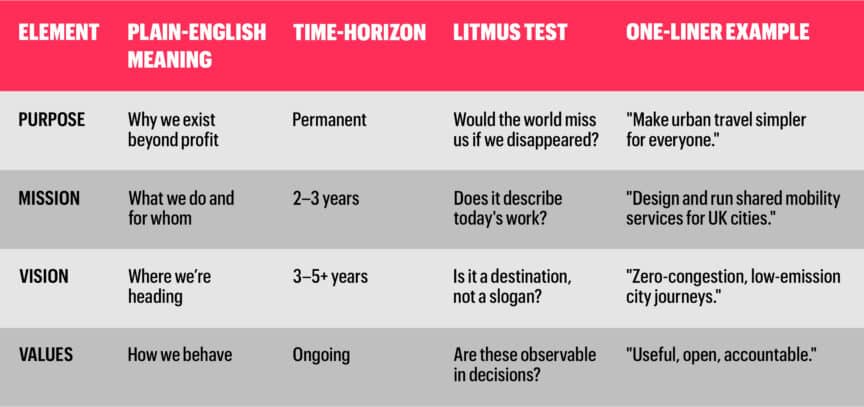
Even seasoned marketers muddle these strategic elements, creating scope-creep that weakens everything. Each serves a distinct function in your brand architecture, and understanding the differences prevents the common mistake of trying to make your purpose do jobs it wasn’t designed for.
- Mission describes what you do and for whom—it’s operational and time-bound.
- Vision paints where you’re heading—it’s aspirational and future-focused.
- Brand purpose explains why you exist—it’s foundational and permanent.
- Values define how you behave—they’re behavioural and ongoing.
Get these relationships right, and each element strengthens the others. Get them wrong, and you end up with strategic soup. This connects closely with how you develop your brand pillars and craft your brand promise.
Purpose vs mission
Mission statements answer “what” and “how”—they describe your current business activities and target audience. Brand purpose definition centres on “why”—it’s your fundamental reason for existing that transcends any particular product or service.
A transport company’s mission might be “connecting people through reliable bus services across the South East.” Their purpose could be “making essential journeys accessible to everyone.” The mission can evolve as markets change; the purpose remains constant.
Purpose vs vision
Vision statements paint a picture of your desired future state—where you want your industry, market, or world to be in five to ten years. Brand purpose explains why that future matters and why you’re the right organisation to help create it.
Vision is about destination; purpose is about motivation. A renewable energy company might envision “a world powered entirely by clean energy.” Their purpose could be “accelerating the transition to sustainable power for future generations.”
Values and behaviours
Values operationalise your brand purpose by defining how you’ll behave as you pursue your reason for existing. They’re the observable principles that guide daily decisions and trade-offs.
If your values don’t influence how you hire, fire, prioritise, and spend, they’re decorative rather than functional. Strong values create consistency between purpose and practice—they’re the bridge between what you stand for and how you act.

How to write a brand purpose statement
Writing an effective brand purpose statement isn’t about crafting the perfect sentence—it’s about uncovering an authentic truth that already exists within your organisation. The best purpose statements feel inevitable once written, as if you’re simply articulating something everyone already knew but couldn’t quite express.
Your brand purpose must be true to who you are, useful for making decisions, and provable through specific actions. It should guide behaviour rather than just describe it, and it must be distinctive enough that competitors couldn’t credibly claim the same thing.
The process matters as much as the output because real purpose emerges from honest reflection, not creative workshops.
The 5-step purpose-statement template
Start with the problem your organisation exists to solve, then work backwards to ensure your purpose is both authentic and actionable. This method forces you to ground lofty aspirations in concrete realities.
How to write a brand purpose statement using our proven framework:
- Insight (the tension): What meaningful customer or cultural problem do you exist to change? Look for tensions that genuinely matter to people and that your industry or organisation is uniquely positioned to address.
- Impact (the change): Define the positive outcome you aim to create and for whom. Be specific about the transformation you’re enabling rather than just describing what you do.
- Fit (why us): Identify the distinctive capability, perspective, or advantage that makes your purpose credible. What can you do that others can’t or won’t?
- Proofs (how we’ll show it): List 3-5 concrete actions, policies, or investments that demonstrate your commitment. These should be specific, measurable, and already planned or in progress.
- The line (the statement): Write a clear, jargon-free sentence that captures steps 1-3. This comes last because the statement should reflect your thinking, not drive it.
Fill-in template: We exist to [positive change] for [who] by [distinctive way], so that [intended outcome]. We’ll prove this through [1], [2], [3].
Quick tests:
- Could a rival say this? If yes, sharpen the fit.
- Can we prove it next quarter? If not, reduce claims or add proofs.
- Does it guide trade-offs? If not, it’s too vague.
- Plain English? If a 15-year-old can’t explain it back, rewrite.
Dos and don’ts
Do be specific about the change you’re creating rather than using generic phrases like “making the world better.” Do anchor your authentic brand purpose in actions you can take and outcomes you can measure.
Do ensure your purpose helps you choose between competing priorities—it should be a useful filter, not a universal truth. Don’t over-reach by claiming to solve problems you’re not equipped to address.
Don’t lean on advertising slogans or marketing language that sounds good but means little. Don’t conflate your purpose with corporate social responsibility programmes—CSR is what you do; purpose is why you exist.

From words to deeds—activating purpose
The graveyard of business literature is littered with purpose statements that never escaped the strategy deck. Real brand purpose only works when it’s embedded across every part of your organisation—from product development to people policies to public communications.
Activation isn’t about internal campaigns or poster campaigns; it’s about systematic integration into the decisions that matter most. When purpose is truly activated, employees don’t need to refer to a document to know what the company stands for—they can see it in hiring patterns, product roadmaps, and resource allocation.
Product & service
Your products and services should be the primary expression of your brand purpose, not your marketing campaigns. Every feature, policy, and customer experience should advance the positive change you exist to create.
This means ruthlessly prioritising roadmap items that serve your purpose and questioning investments that don’t. Purpose-washing occurs when organisations talk about change but don’t embed it systematically into product decisions.
People & culture
Your brand purpose should influence who you hire, how you structure teams, what behaviours you reward, and how you handle difficult decisions. Purpose-driven recruitment looks for people who are energised by your reason for existing, not just skilled at specific tasks.
Recognition systems should celebrate actions that advance your purpose alongside traditional performance metrics. Team rituals and communications should reinforce the connection between daily work and larger impact.
Communications & brand
The temptation with purpose-driven communications is to tell people how wonderful you are rather than showing them the change you’re creating. Resist it. Your communications should publish progress rather than make promises, share learning rather than claim perfection.
This is where your verbal identity becomes crucial—how you talk about your purpose matters as much as the purpose itself. Regular updates on specific commitments build credibility more effectively than broad statements about values.

Brand purpose examples in action
The most compelling brand purpose examples share a common trait: they prioritise concrete actions over eloquent statements. These purpose-driven brands have moved beyond purpose as positioning to purpose as practice, creating tangible change that customers, employees, and communities can see and experience.
Kantar’s BrandZ research shows that brands with strong purpose grow twice as fast as those without. The following examples demonstrate how different organisations have translated worthy intentions into measurable impact.
Patagonia
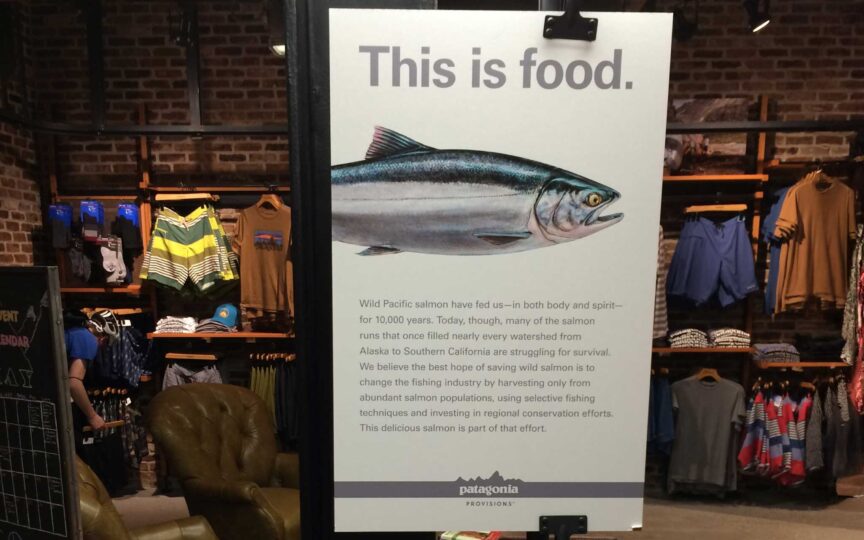
Environmental responsibility through product design
“We’re in business to save our home planet” translates into systematic design decisions that prioritise durability, repairability, and environmental impact over short-term profits. Their “Don’t Buy This Jacket” campaign actively encourages customers to buy less and repair more.

Unilever
Sustainable living through everyday products
“Making sustainable living commonplace” drives product reformulation across thousands of SKUs, from reducing plastic packaging to eliminating palm oil from supply chains. Their purpose-driven brands consistently outperform traditional equivalents in both growth and profit margins.

Microsoft
Democratising technology through accessibility
“To empower every person and every organisation on the planet to achieve more” influences hiring practices, product development, and accessibility standards across all platforms. Their Gaming Accessibility Guidelines are now industry standard.
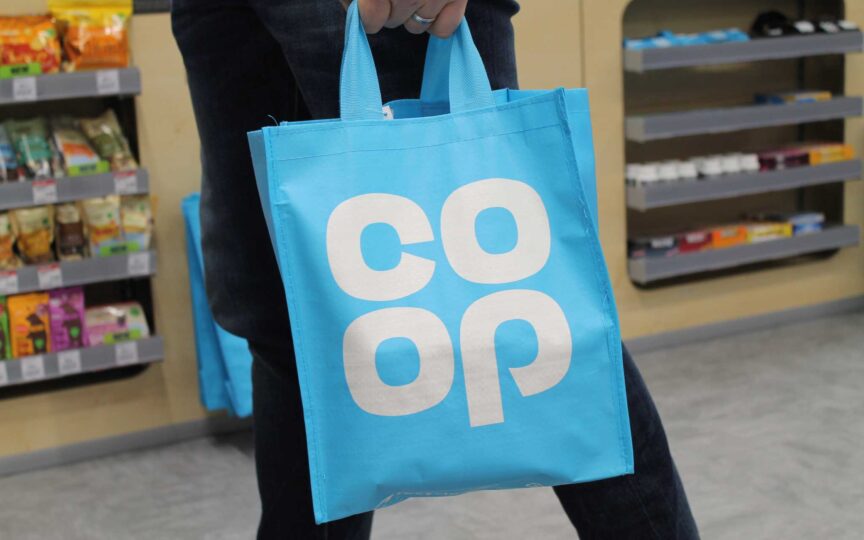
The Co-operative Group
Community ownership through business model
“Championing a better way of doing business” manifests through democratic decision-making structures, ethical sourcing policies, and profit-sharing with local communities. Members vote on major business decisions and share in annual profits.

Innocent Drinks
Natural nutrition through transparent ingredients
“Making it easy for people to do themselves good” drove the elimination of artificial additives, clear labelling practices, and the Big Knit campaign that has raised millions for Age UK while creating community engagement around their brand.
Measuring purpose
Purpose without measurement is just expensive theatre. The most effective purpose-driven organisations track their progress across multiple dimensions—brand perception, employee engagement, and tangible social or environmental impact.
They publish regular updates on specific commitments rather than generic sustainability reports, and they’re transparent about setbacks alongside successes. Research from the IPA on brand purpose effectiveness shows that purpose works best when it’s measurable and accountable.
Brand & customer metrics
Track customer preference, consideration, and pricing power alongside traditional commercial metrics to understand whether your purpose creates sustainable competitive advantage. Net Promoter Score, brand consideration studies, and price sensitivity analysis should all show directional improvement.
Repeat purchase rates and customer lifetime value often improve when people buy into your purpose alongside your product. Trust indicators—measured through independent surveys rather than internal research—provide early warning signals when purpose and practice diverge.
Employee indicators
People metrics reveal whether your purpose resonates internally or remains leadership rhetoric. Employee Net Promoter Score, voluntary turnover rates, and internal referral rates should all improve as purpose becomes more authentic and visible.
Track recruitment conversion rates for purpose-aligned roles versus traditional positions. Monitor engagement scores specifically around questions related to meaning, impact, and organisational pride. Leading organisations like Adobe use sophisticated measurement frameworks to track purpose effectiveness across employee touchpoints.
Proof over posture
The most credible purpose measurement combines internal progress tracking with external verification. Publish specific commitments with clear timelines rather than aspirational statements about future intentions.
Small, steady wins build more credibility than grand announcements followed by silence. When you miss targets, explain why and adjust your approach rather than quietly moving the goalposts. This approach helps you measure brand purpose success effectively.

When purpose becomes practice
Brand purpose works when it guides decisions rather than decorates presentations. The organisations succeeding with purpose have moved beyond worthy statements to systematic integration—embedding their reason for existing into products, policies, and people decisions.
They measure progress honestly, communicate specifically, and treat purpose as a practical tool for creating sustainable competitive advantage. Harvard Business Review research confirms that purpose-driven organisations outperform their peers when purpose is genuinely embedded rather than superficial.
The question isn’t whether your organisation needs a brand purpose—it’s whether you’re brave enough to let that purpose change how you operate. When purpose becomes practice, everything else follows.
Ready to move from purpose statements to purpose-driven strategy? Our team specialising in strategic brand development helps organisations uncover authentic purpose and embed it systematically across their business. We also provide comprehensive guidelines to ensure your purpose translates consistently across all touchpoints.
For deeper strategic work, explore our approach to brand positioning that connects purpose with market reality.
Frequently asked questions
What is brand purpose?
Brand purpose is your organisation’s reason for existing beyond making profit—the positive change you’re uniquely positioned to create in the world that guides your decisions and shapes your behaviour.
Is brand purpose the same as CSR?
No. Corporate Social Responsibility consists of specific programmes and initiatives you run alongside your business. Brand purpose is the fundamental reason your business exists and should influence every aspect of how you operate.
Brand purpose vs mission vs vision—what’s the difference?
Purpose explains why you exist (permanent and foundational), mission describes what you do and for whom (operational and time-bound), and vision paints where you’re heading (aspirational and future-focused).
Do small brands need a brand purpose?
Yes, often more than large brands. Small businesses typically have clearer founder motivations and can embed purpose more quickly across all operations. Purpose helps small brands compete against larger competitors by creating emotional connection alongside functional benefits.
How do you measure brand purpose?
Track brand and customer metrics (preference, consideration, pricing power), employee indicators (engagement, retention, referrals), and specific outcomes related to your stated purpose. Focus on proof over posture by publishing regular progress updates on concrete commitments.

Clarity starts with a conversation.
Thanks—we’ll get back to you shortly.
Whether you're navigating a rebrand, merger, or simply need a clearer identity—we’re here to help. No hard sell, just honest advice from people who know the sector.
Let’s start with a simple question…
Prefer to email? Drop us a line.
Fabrik’s been helping organisations rethink and reshape their brands for over 25 years. We’ve guided companies through mergers, rebrands and new launches. Whatever stage you’re at, we’ll meet you there.


.jpg)