






Brand guidelines don’t matter… until they really do

It was 3am when the marketing director’s phone buzzed with a message that would haunt her for months: “Just reviewed the pitch deck for tomorrow’s meeting. This doesn’t look like our brand at all – we can’t present this to the client.” What started as final preparations for a routine pitch had become a masterclass in why the importance of brand guidelines cannot be overlooked.
Furthermore, the marketing team had used one colour palette, the sales director had added slides with different fonts, and the graphics pulled from various sources looked nothing like their website.
Somewhere between conception and delivery, the brand had fractured into unrecognisable pieces. This wasn’t an isolated incident.
Instead, it was the inevitable result of treating brand consistency as optional rather than essential.
The moment everything fell apart
The scene plays out in boardrooms across Britain every week. Consequently, a promising business relationship crumbles because mixed messages create confusion.
Similarly, a product launch stumbles because different teams present conflicting visual identities. Moreover, an acquisition stalls because the brand appears chaotic and unmanaged.
Consider the technology startup that secured a crucial investor meeting after months of persistence. Their pitch deck featured sleek visuals, confident messaging, and compelling data.
However, when the investor visited their website, everything changed. The colour palette was different, the tone shifted from authoritative to casual, and the logo appeared in three separate variations.
The investor’s conclusion was swift: if they couldn’t maintain internal consistency, how could they be trusted with millions in funding?
This represents a classic example of brand guidelines failures in action.
The credibility crisis
Brand documentation isn’t just about aesthetics—it’s about credibility. When Nielsen Norman Group research demonstrates that consistency directly impacts user trust and comprehension, the stakes become clear.
Additionally, every touchpoint where your brand appears inconsistently is a moment where trust erodes. These real-world branding examples highlight the commercial impact of inconsistent branding.
The costly lesson
The startup eventually secured funding, but only after spending six months rebuilding their brand identity systems and creating comprehensive brand guidelines.
The lesson was expensive but invaluable: brand clarity beats chaos, every time.

Why brand guidelines are ignored (until they’re needed most)
The irony of brand governance is timing. Companies resist creating guidelines when they’re small and agile, then desperately need them when they’re large and complex.
Nevertheless, this resistance stems from three dangerous misconceptions that plague growing organisations:
- Treating guidelines as a ‘nice to have’ rather than necessity.
- Believing brand knowledge can remain in someone’s head indefinitely.
- Assuming teams are naturally aligned without documentation.
Seen as a ‘nice to have’, not a necessity
Marketing budgets are finite, and brand guidelines often lose the battle against immediate revenue drivers. Consequently, this thinking treats branding as decoration rather than infrastructure.
The misconception persists because guideline failures aren’t immediately visible. Unlike a broken website or failed product launch, inconsistent branding creates slow-burning damage.
Subsequently, customers gradually lose confidence, internal teams waste time on repeated decisions, and the brand’s value quietly diminishes.
Understanding why guidelines are important helps organisations recognise their strategic value beyond aesthetic control.
“It’s all in my head” syndrome
Founders and creative directors often believe they can maintain brand consistency through personal oversight. This works brilliantly—until it doesn’t.
When the business grows beyond their direct influence, or when they’re unavailable for every decision, the brand begins to drift.
For example, a marketing campaign might go live with inconsistent fonts, an outdated logo, or incorrect brand colour usage because different team members or freelancers made independent decisions in the absence of clear, documented guidelines.
Therefore, the importance of brand guidelines became painfully clear when her absence revealed the implementation gaps.
The illusion of alignment
Teams often believe they understand the brand intuitively. They’ve attended the same meetings, heard the same presentations, and absorbed the same cultural cues.
However, this creates a dangerous illusion where everyone thinks they’re aligned while interpreting the brand differently.
Implementation gaps become visible during pressure moments:
- Tight deadlines creating rushed decisions.
- New team members lacking context.
- External partnerships requiring briefing.
- Crisis communications demanding swift response.
When there’s no documented reference point, people make assumptions. Those assumptions, however well-intentioned, lead to design misalignment and messaging inconsistencies.

The hidden cost of poor governance
Brand governance failures aren’t just aesthetic problems—they’re business liabilities. While the immediate costs might seem manageable, the cumulative impact of inconsistent branding creates significant hidden expenses that compound over time.
Inconsistencies = lost trust
Harvard Business Review research shows that trust drives customer loyalty and premium pricing power. When your brand appears differently across touchpoints, customers unconsciously question your reliability and professionalism.
A financial services firm discovered this when client feedback revealed confusion about their identity. The website presented them as innovative disruptors, the literature positioned them as established experts, and their social media suggested they were approachable specialists.
Consequently, clients couldn’t identify what the company stood for, leading to longer sales cycles and increased price sensitivity. These branding mistakes compound quickly in digital environments where customers compare options instantly.
Wasted time, duplicated effort
Without clear brand documentation, teams constantly reinvent basic elements. Design briefs get repeated, colour choices get debated, and messaging gets rewritten.
This creates enormous inefficiency as multiple people solve the same problems independently:
- Design teams recreating basic templates.
- Marketing departments rewriting brand descriptions.
- Sales teams developing inconsistent presentations.
- HR departments creating off-brand recruitment materials.
Consider how much time gets wasted when teams debate the same decisions repeatedly…
- Which shade of blue should we use?
- What’s our official tone of voice?
- Can we use this font variation?
These conversations happen in meeting rooms across the country, consuming valuable hours that could be spent on strategic work.
Without clear documentation, these brand-related discussions become recurring expenses that drain both time and budget from more productive activities.
Misinterpretation and message drift
Verbal identity and messaging guidelines prevent gradual dilution of brand positioning. Without documented tone, language principles, and messaging frameworks, your brand voice slowly shifts as different people interpret it differently.
This message drift can be subtle but devastating, particularly for companies built on specific expertise or values.
Without clear verbal guidelines, messaging can shift from “industry-leading expertise” to “we’re passionate about helping” or from “premium quality solutions” to “affordable and friendly service”.
These changes seem minor individually but collectively alter how customers perceive your brand’s positioning and value proposition.

When guidelines come to the rescue
Effective brand guidelines transform from constraint to catalyst, enabling rather than restricting creative output. Companies with robust brand documentation consistently outperform those without, particularly during growth phases and market expansion.
Campaigns that land consistently
Medialake’s research on brand governance demonstrates that documented brand standards accelerate creative development while maintaining consistency. Teams spend less time debating basics and more time crafting compelling communications.
When teams have comprehensive guidelines covering colour usage, messaging hierarchy, and visual standards, they can create cohesive campaigns without constant oversight.
Marketing teams in different regions can develop materials that feel unified rather than fragmented. Sales presentations align with website design. Social media posts reinforce rather than contradict brand positioning.
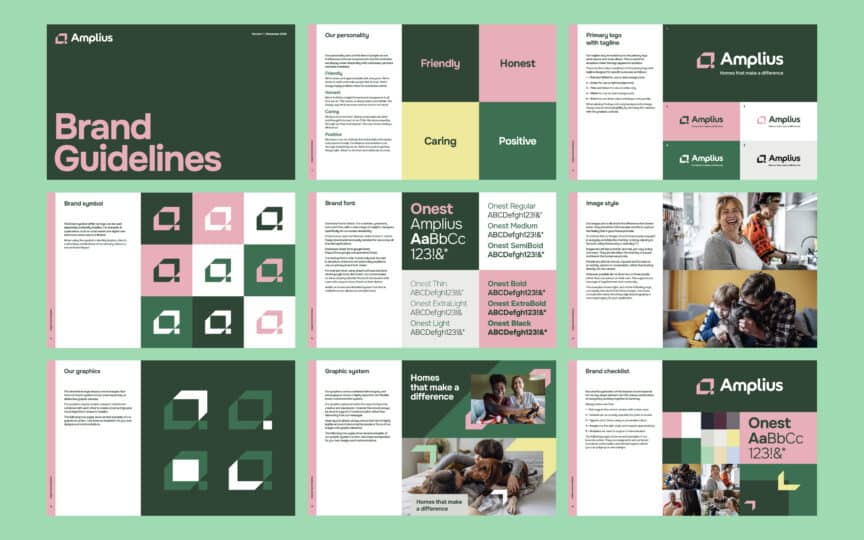
This approach proved essential for organisations like Amplius during their merger, where clear brand guidelines ensured consistent implementation across multiple touchpoints and stakeholder communications.
Why brand guidelines matter becomes obvious when campaigns reinforce rather than confuse brand positioning.
The strategic advantage
Design once, deploy everywhere isn’t just efficient—it’s strategically powerful. When teams have clear visual and messaging standards, they can execute consistently across all touchpoints without reinventing the wheel for each project.
Moreover, comprehensive visual identity systems enable consistent execution across all touchpoints without constant oversight.
Faster onboarding, fewer mistakes
New team members, external agencies, and freelance partners need reference points to contribute effectively. Comprehensive brand guidelines eliminate guesswork and reduce the revision cycles that plague creative projects.
Benefits include:
- Reduced briefing time for external partners.
- Faster decision-making during creative reviews.
- Fewer revision rounds on marketing materials.
- Consistent output from distributed teams.
Clear brand guidelines dramatically reduce project timelines by eliminating guesswork and revision cycles.
External partners can brief themselves independently, internal stakeholders can reference documented standards during feedback, and creative decisions have clear criteria rather than subjective preferences.
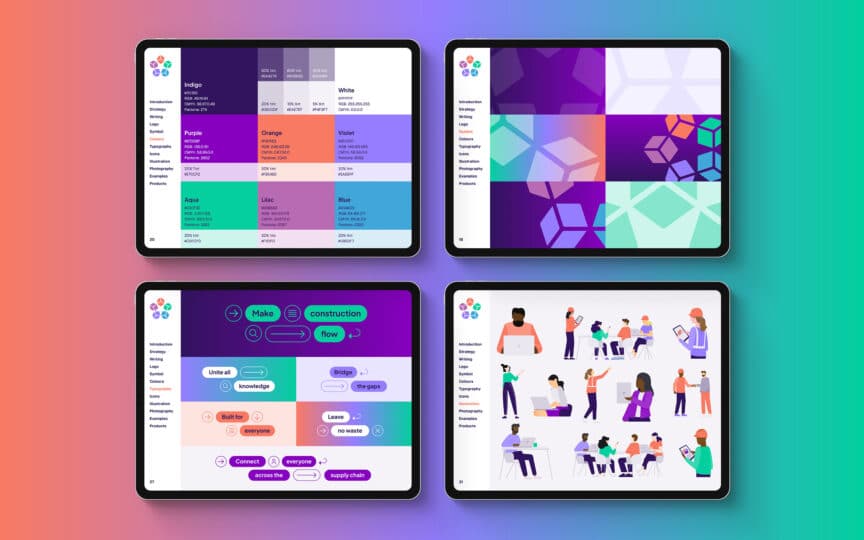
Organisations like Causeway exemplify how strategic brand guidelines accelerate decision-making while maintaining quality and consistency across all communications.
Protecting the brand as it grows
Scalability demands systematisation, and brand guidelines provide the framework for maintaining identity integrity across expanding operations.
Documentation is implementation—it transforms brand strategy from dependent on individual knowledge to embedded in organisational processes.
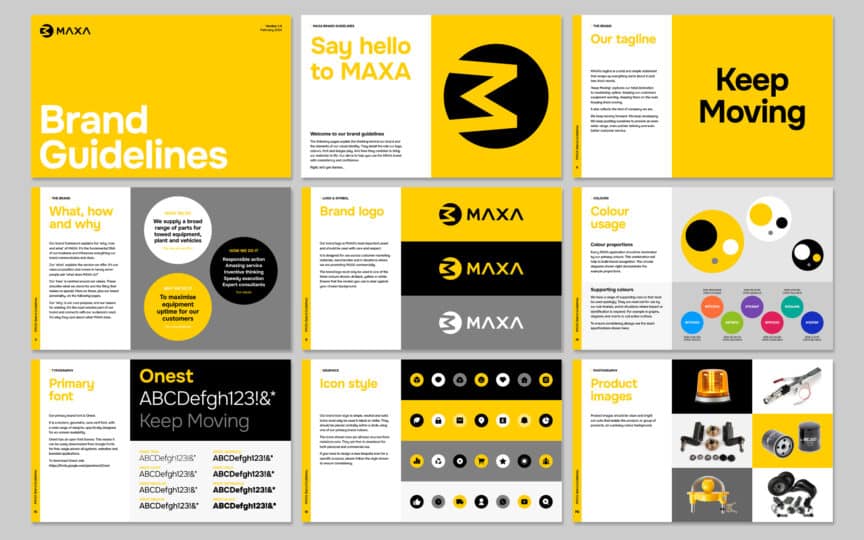
Complex organisations like MAXA Group demonstrate how comprehensive brand guidelines enable consistent execution across multiple business units while maintaining strategic coherence.
Internal brand adoption improves dramatically when teams have accessible, comprehensive references. Guidelines aren’t bureaucracy; they’re infrastructure that enables growth without losing brand coherence.
Comprehensive documentation ensures that nothing gets overlooked as your brand evolves and grows.

Document or be damned
The most dangerous phrase in brand management isn’t “we need to rebrand”—it’s “everyone knows what our brand is.” This false confidence leads to the gradual erosion of brand value through a thousand small inconsistencies.
The importance of brand guidelines isn’t theoretical—it’s commercial.
Companies that document and govern their brands systematically outperform those that rely on intuition and good intentions. Brand consistency drives customer trust, operational efficiency, and scalable growth.
The question isn’t whether you can afford to create comprehensive brand guidelines. It’s whether you can afford not to. Because while brand guidelines might not matter today, they certainly will tomorrow.
From chaos to codified isn’t just good practice—it’s good business. Why brand guidelines matter becomes crystal clear when you witness the transformation they create.
The companies that recognise this early gain competitive advantage. Those that learn it late pay premium prices for the lesson. Consistency is commercial, and the market rewards those who understand this fundamental truth.
Ready to transform your brand from chaos to codified? Discover how professional brand guidelines can protect and amplify your brand’s value across every touchpoint.

Clarity starts with a conversation.
Thanks—we’ll get back to you shortly.
Whether you're navigating a rebrand, merger, or simply need a clearer identity—we’re here to help. No hard sell, just honest advice from people who know the sector.
Let’s start with a simple question…
Prefer to email? Drop us a line.
Fabrik’s been helping organisations rethink and reshape their brands for over 25 years. We’ve guided companies through mergers, rebrands and new launches. Whatever stage you’re at, we’ll meet you there.
