










How to build a college brand that resonates locally and competes nationally

In today’s competitive education landscape, further education colleges face a delicate balancing act. Their brands must simultaneously nurture deep local roots while projecting credibility on the national stage. This isn’t merely a communications challenge—it’s a strategic imperative that affects recruitment, partnerships, funding opportunities and institutional growth.
At Fabrik, we’ve observed that the most successful college branding strategies don’t force institutions to choose between community relevance and broader ambition.
Instead, they weave both elements into a coherent identity that works across multiple contexts and audience groups.
The question isn’t whether to prioritise local or national positioning—it’s how to build a brand architecture flexible enough to do both effectively.
Why local relevance still matters in college branding
In an age of globalisation and digital connectivity, it might be tempting to downplay geographical ties in favour of more universal positioning. However, our experience with education brands suggests this would be a strategic misstep.
Local connections remain a fundamental strength for FE colleges—one that larger universities and national training providers often struggle to replicate. Understanding and leveraging this distinctive advantage creates a solid foundation for any college brand strategy.
The college as a community anchor
Further education colleges aren’t just educational institutions; they’re vital social and economic hubs embedded in their communities.
According to Association of Colleges research, approximately 2.2 million students attend UK colleges each year, with the majority studying within 10 miles of their home.
This geographical connection means that successful college brands must reflect and respect the distinctive character of their locations.
When we partnered with East Kent College on their rebrand, we recognised the institution’s deep roots in the coastal communities of Broadstairs, Dover, Folkestone and Canterbury.
The resulting brand identity didn’t shy away from this heritage—it celebrated it, positioning the college as an essential thread in the fabric of East Kent.
This approach doesn’t diminish a college’s ambitions; rather, it acknowledges that strong regional identity creates the foundation for broader growth.
Reflecting local culture, values and voices
The most resonant college brands capture authentic local narratives. This means going beyond superficial references to landmarks or history and instead embedding community values, aspirations and cultural reference points into brand communications.
Effective strategies might include featuring success stories from local employers who’ve benefited from college partnerships, showcasing students who’ve transformed their lives without leaving their community, or visual design systems that subtly reference regional industrial heritage, natural landscapes, or cultural traditions.
At Central Bedfordshire College, the brand we developed captured the institution’s role in connecting students to opportunity through learning—a narrative that spoke directly to the aspirations of the local community while communicating values with universal appeal.

Competing on a national stage: why broader visibility matters
While deeply embedded in their communities, colleges can’t afford to operate in geographic isolation. The education landscape has evolved dramatically, with digital learning, specialist provision and increased student mobility blurring traditional catchment boundaries.
Forward-thinking institutions recognise that developing a brand with broader resonance isn’t about abandoning local roots—it’s about extending their reach and influence while securing long-term sustainability.
Beyond borders – attracting students, staff and partners
While local engagement remains crucial, colleges increasingly need to look beyond their immediate catchment areas. Demographic shifts, funding pressures, and the need for diversified income streams mean that attracting students, partners and talent from further afield has become essential for sustainable growth.
A college brand with national credibility opens doors to strategic partnerships with universities, national employers and industry bodies. It helps attract specialist teaching staff who might otherwise gravitate toward higher education institutions.
And critically, it allows colleges to weather local demographic downturns by appealing to students willing to travel or relocate for the right educational opportunity.
Reputation signals and perceived quality
In education, perception powerfully influences reality. A college brand that projects professionalism, innovation and ambition creates positive assumptions about the quality of its provision—assumptions that matter to prospective students, parents, employers and partners.
This effect is particularly important for colleges looking to develop higher-level technical provision, degree apprenticeships or specialist industry training centres. When competing with universities or private training providers for these opportunities, colleges need brands that signal sectoral leadership, not just local relevance.
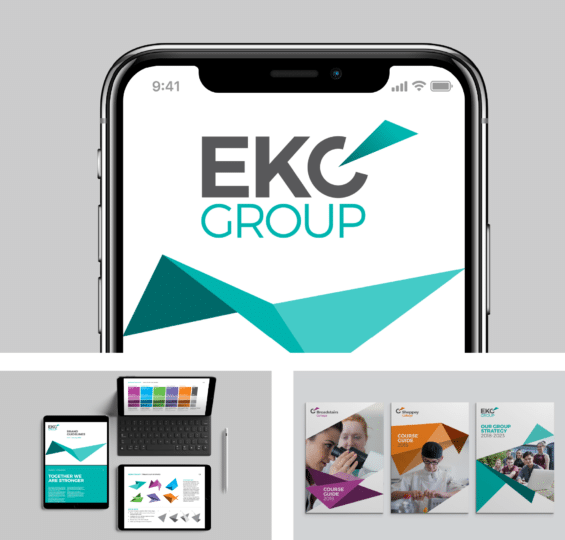
The rebranding work we conducted with East Kent College helped position them as a serious player in regional skills development and higher technical education.
Through consistent application across multiple touchpoints—from their digital presence to campus environments—their brand now communicates an institution with both local understanding and broader ambition.

Balancing local authenticity with national ambition: a strategic approach
Successfully navigating this dual positioning requires a deliberate approach rather than leaving it to chance.
Based on our work with numerous further education institutions, we’ve identified five core principles that help colleges develop brands with both local authenticity and broader credibility.
These principles form a practical framework that marketing teams can apply regardless of their college’s size, location or specialist focus.

Principle 1 – define what’s distinctive locally
The foundation of any effective college brand is clarity about what makes the institution genuinely distinctive. This isn’t about inventing differences but uncovering existing strengths and authentic character traits that matter to key audiences.
Colleges should conduct thorough brand discovery exercises that engage multiple stakeholders—not just senior leadership, but teaching staff, support teams, current students, alumni, employers and community partners.
These conversations often reveal differentiators that management teams take for granted but which have significant emotional resonance with stakeholders.
Talk to your community—don’t assume you already know
When we worked with Central Bedfordshire College, our discovery phase revealed that their most distinctive quality wasn’t a particular subject specialism or facility, but rather their approach to personalised learning journeys and ongoing pastoral support.

This insight emerged from conversations with students and employers, not from management assumptions.
This kind of authentic insight becomes the foundation for a distinctive brand proposition—one that reflects real institutional strengths rather than aspirational messaging that the college cannot deliver against.

Principle 2 – build a brand that travels
While grounding your college brand in local realities, ensure it’s constructed to make sense beyond your immediate geography.
This means creating visual identities, verbal frameworks and core messaging that communicate clearly to audiences with no prior knowledge of your institution or region.
Avoid hyper-local references that exclude broader audiences
A common pitfall is over-reliance on local cultural references, dialect terms or historical allusions that confuse outside audiences.
Instead, balance place-based elements with universal values and aspirations—opportunity, excellence, innovation, inclusion—that resonate regardless of geography.
The East Kent College brand we developed uses a bold, contemporary visual system that works as effectively in national educational forums as it does in local recruitment campaigns.
The brand communicates a clear benefit that appeals to students across demographic and geographic boundaries while maintaining a sense of place.

Principle 3 – position for multiple audiences without losing focus
Successful college brands must communicate effectively with diverse audience groups—from 16-18 year-old school leavers to adult returners, employers, community partners and policy stakeholders.
The challenge is maintaining coherence while speaking to these different audiences’ needs and priorities.
Rather than trying to address everyone simultaneously with generic messaging, develop a clear brand architecture that allows for audience-specific communication while maintaining consistent core values and visual identity.
Use audience personas to refine brand tone and messaging
Developing detailed audience personas helps ensure your brand communication strikes the right tone with different groups.
For example, communications targeting employers might emphasise outcomes, efficiency and business benefits, while those aimed at young learners might focus more on experience, support and progression opportunities—all while maintaining consistent brand values and identity elements.
Central Bedfordshire College’s brand framework includes flexible messaging hierarchies that adapt to different audience segments without diluting the core brand proposition.
This approach allows for tailored communication while maintaining brand coherence.

Principle 4 – build from the inside out
No college brand succeeds without internal alignment and advocacy. Staff and students are your most powerful brand ambassadors—or your most damaging detractors if they don’t believe in or understand the brand promise.
Involve internal stakeholders from the earliest stages of brand development, not just in implementation. Explain the strategic rationale behind brand decisions, provide clear guidelines and resources, and celebrate those who embody the brand values in their daily work.
Internal launch activities should be at least as comprehensive as external ones.
At East Kent College, we facilitated staff engagement workshops, created comprehensive brand guidelines with practical examples, and worked closely with brand champions to support consistent implementation across multiple campuses.

Principle 5 – align brand strategy with long-term college goals
Your brand should never exist in isolation from broader institutional strategy. The most effective college brands directly support key strategic objectives—whether that’s growing apprenticeship provision, developing higher technical qualifications, or strengthening employer partnerships.
This alignment ensures that brand development receives appropriate investment and senior-level support. It also provides clear metrics for measuring brand effectiveness beyond subjective aesthetic judgments or application consistency.
When we partner with colleges on brand development, we always start by understanding their strategic plan, growth priorities and educational vision.
This ensures that the resulting brand becomes a powerful tool for achieving institutional goals, not just an exercise in visual refreshment.
Real college branding in action: what works
Across the sector, several colleges have successfully balanced local resonance with broader appeal in their branding approaches.
The Newcastle College Group (NCG) has developed a sophisticated brand architecture that balances the local identity of its member colleges with the scale and resources of the wider group.
Each college maintains its distinctive local character while benefiting from association with a national organisation.
Similarly, Activate Learning has created a brand that works across multiple geographies while maintaining connection to local communities. Their focus on “learning philosophy” rather than location gives them flexibility to operate across regions while still addressing specific local needs.
East Kent College’s rebrand demonstrates how a multi-campus institution can unify its identity while respecting the distinct character of different locations. Their brand positioning works equally well for school leavers in Folkestone, adult learners in Canterbury, or employers across the region.
Central Bedfordshire College’s brand emphasises the institution’s role as a nexus between learners, employers and communities. This positioning transcends purely local references while still acknowledging the college’s central role in its region.
The most successful examples share common characteristics: they’re built on authentic differentiators, they balance local references with universal values, and they maintain consistent core elements while allowing flexibility for different contexts and audiences.

Common pitfalls in college branding (and how to avoid them)
Even well-resourced branding projects can falter when they encounter certain recurring challenges. Our experience guiding colleges through rebranding exercises has highlighted several predictable stumbling blocks that frequently derail otherwise promising initiatives.
By anticipating these issues early in your brand development process, you can build in safeguards and ensure your investment delivers lasting strategic value.
Over-indexing on local clichés
Many colleges fall into the trap of leaning too heavily on obvious local references—landmarks, heritage industries, or regional stereotypes—that create a parochial impression and limit broader appeal.
Instead, look deeper for authentic local connections that also have universal resonance.
Inconsistency across multi-campus estates
Colleges with multiple sites often struggle to maintain brand consistency while acknowledging campus differences. Develop clear guidelines for when localisation is appropriate and when core brand elements must remain consistent.
Ignoring internal adoption
No matter how impressive your external brand launch, if staff don’t understand and embody the brand values, the investment is wasted. Dedicate significant resources to internal engagement, training and regular reinforcement.
Forgetting digital platforms
Your brand will increasingly be experienced first (and sometimes exclusively) through digital channels.
Ensure your brand works effectively across websites, social media platforms, online learning environments and digital marketing materials—not just on prospectuses and signage.
Failing to plan for brand growth
Many college brands are developed for current circumstances without considering how they’ll adapt to future strategic developments—whether that’s new campus locations, merged institutions, or expanded provision.
Build flexibility into your brand architecture from the start.

Create a brand that works locally—and travels well
The strongest college brands don’t force a choice between local roots and national ambition. Instead, they create a coherent identity that celebrates institutional heritage and community connections while positioning the college credibly on a broader stage.
At Fabrik, we’ve seen how this balanced approach creates brands with both emotional resonance and strategic impact.
By grounding brand development in authentic institutional strengths, engaging stakeholders throughout the process, and creating flexible frameworks that work across contexts and audiences, colleges can develop brands that truly support their educational and strategic ambitions—locally, regionally and beyond.
If you’re interested in discussing how Fabrik could support your college’s brand development, please contact our team for an initial consultation.
Fabrik: A branding agency for our times.

Clarity starts with a conversation.
Thanks—we’ll get back to you shortly.
Whether you're navigating a rebrand, merger, or simply need a clearer identity—we’re here to help. No hard sell, just honest advice from people who know the sector.
Let’s start with a simple question…
Prefer to email? Drop us a line.
Fabrik’s been helping organisations rethink and reshape their brands for over 25 years. We’ve guided companies through mergers, rebrands and new launches. Whatever stage you’re at, we’ll meet you there.
