





Brand marketing vs digital marketing: What’s the real difference?

Marketing teams everywhere grapple with the same head-scratcher: what’s the actual difference between brand marketing and digital marketing? The terms get tossed around interchangeably in boardrooms and strategy sessions, creating confusion that costs businesses real money.
Whether you’re debating brand marketing vs digital marketing strategies or trying to understand how these approaches complement each other, the distinction matters more than most marketers realise.
While digital marketing grabs headlines with its flashy metrics and immediate results, brand marketing quietly builds the foundation that makes those tactics work.
At Fabrik, we believe strategy comes before tactics—and understanding this brand marketing vs digital marketing dynamic is where smart marketing begins.
What is brand marketing?
Brand marketing is the art of building long-term relationships with your audience through strategic positioning, consistent messaging, and emotional connection. It’s not about quick wins or immediate conversions.
Instead, brand marketing focuses on creating lasting value in the minds of consumers—value that compounds over time and becomes increasingly difficult for competitors to replicate.
As the Chartered Institute of Marketing defines it, marketing is fundamentally about understanding and meeting customer needs—and brand marketing takes this principle to its strategic conclusion.
This discipline takes the long view, prioritising brand equity over instant gratification. Brand marketers craft narratives, establish market position, and build trust that extends far beyond any single campaign or touchpoint.
They work with abstract concepts like perception, reputation, and emotional resonance—elements that can’t be measured in real-time but drive purchasing decisions for years.
Brand marketing operates at the category level, shaping how customers think about entire product categories rather than just individual offerings. It’s about becoming the brand that customers think of first when they have a particular need.
This mental real estate becomes increasingly valuable as markets mature and competitive differentiation becomes harder to achieve through product features alone.
The long game of brand building
Brand building operates on a completely different timeline than most marketing activities. While a paid search campaign might run for weeks, brand equity develops over years and decades.
This patient approach creates something remarkable: genuine customer loyalty that survives market downturns, price increases, and competitive pressure.
Companies with strong brand equity can charge premium prices because customers associate their products with quality, reliability, or status.
The compound effect of brand building means that early investments in brand equity pay dividends for years. Each positive brand interaction builds on previous ones, creating a snowball effect that becomes increasingly powerful over time.
This is why established brands can maintain market leadership even when newer competitors offer superior products or lower prices—they’ve built emotional connections that transcend rational decision-making.
Brand building also creates what marketers call “mental availability”—the likelihood that your brand comes to mind when customers are ready to make a purchase.
This mental real estate is finite and valuable, which is why brand marketing focuses on creating distinctive assets, memorable positioning, and consistent experiences that stick in customers’ minds.
Examples of brand-led marketing in action
Think about how Apple transformed from a computer company to a lifestyle brand, or how Nike elevated trainers into symbols of athletic achievement.
These brands didn’t achieve market dominance through clever ad targeting alone—they built emotional connections that make customers choose them even when cheaper alternatives exist.
Their brand marketing created mental shortcuts that influence purchasing decisions at an unconscious level.
Consider Patagonia’s commitment to environmental activism, which attracts customers who share those values and are willing to pay premium prices for products that align with their beliefs.
Or examine how Volvo built decades of market share by consistently positioning itself around safety—a brand promise so strong that “safety” and “Volvo” became almost synonymous in many consumers’ minds.
These examples demonstrate how brand marketing transcends product features to create meaningful differentiation:
- Apple: Customers buy into design philosophy and cultural identity, not just technology
- Nike: “Just Do It” mentality creates emotional alignment beyond footwear functionality
- Patagonia: Environmental values attract like-minded customers willing to pay premiums
- Volvo: Safety positioning creates instant mental association and trust
When someone chooses Nike over Adidas, they’re often expressing alignment with Nike’s mentality rather than making a purely functional decision about footwear.
What is digital marketing?
Digital marketing encompasses the tactical execution of campaigns across digital channels to drive measurable results. It’s the sharp end of marketing—focused on conversion rates, click-through rates, and return on ad spend.
Digital marketers live in the world of real-time optimisation, A/B testing, and performance metrics.
Understanding the brand marketing vs digital marketing distinction becomes clearer when you examine how digital marketing operates. This approach excels at generating immediate, trackable outcomes.
Digital marketing can turn prospects into customers, drive traffic to specific landing pages, and deliver precise attribution data that shows exactly which efforts generated which results.
The beauty of digital marketing lies in its accountability—every pound spent can be traced to specific outcomes, making it easier to justify marketing investments and optimise spend allocation.
Digital marketing thrives in the world of data and automation. Machine learning algorithms optimise bids in real-time, programmatic advertising targets audiences with surgical precision, and marketing automation nurtures leads through sophisticated sequences.
This technological sophistication enables marketers to reach the right people with the right message at exactly the right moment—something that was impossible in traditional marketing channels.
However, as Harvard Business Review points out in their analysis of branding in the digital age, many companies are investing heavily in digital tactics while neglecting the brand foundation that makes those tactics effective.
The tactical side of digital
Digital marketing thrives on speed and adaptability. Campaigns can launch within hours, audiences can be refined based on performance data, and budgets can shift towards the highest-performing channels in real time.
This tactical flexibility makes digital marketing incredibly powerful for hitting specific targets—whether that’s generating leads for a sales team or driving downloads for a new app.
The granular control available in digital marketing enables sophisticated testing and optimisation strategies. Marketers can test different headlines, images, calls-to-action, and landing page designs to identify the combinations that drive the highest conversion rates.
This iterative approach means digital campaigns improve continuously, with each test revealing insights that inform future optimisation efforts.
Digital marketing also excels at personalisation at scale. Dynamic content delivery ensures that different audience segments see messages tailored to their interests, behaviours, and stage in the buying journey.
This level of customisation would be impossible in traditional media but becomes standard practice in digital channels.
Where digital shines
Digital marketing dominates in environments where immediate action is the goal. E-commerce conversions, event registrations, newsletter sign-ups, and software trials all play to digital marketing’s strengths.
The ability to track customer behaviour across multiple touchpoints provides unprecedented insight into what motivates purchases and how to optimise each step of the customer journey.
Performance marketing within digital channels excels at capturing demand that already exists in the market. When someone searches for “project management software,” a well-optimised Google Ads campaign can capture that intent and convert it into a trial or purchase.
This demand capture is fundamentally different from demand creation—it’s about being present when customers are ready to buy rather than influencing when they decide to buy.
This distinction highlights the difference between brand marketing vs performance marketing: brand marketing creates the demand, while performance marketing captures it.
Digital marketing also provides sophisticated attribution modelling that helps marketers understand the complete customer journey. Multi-touch attribution reveals how different digital touchpoints contribute to conversions, enabling smarter budget allocation and campaign optimisation.
This level of insight transforms marketing from guesswork into a data-driven discipline and shows why brand marketing vs direct marketing approaches require different measurement frameworks.
Brand marketing vs digital marketing: Spotting the difference
Understanding where brand marketing ends and digital marketing begins transforms how you approach your marketing mix. The two disciplines serve different masters and measure success differently.
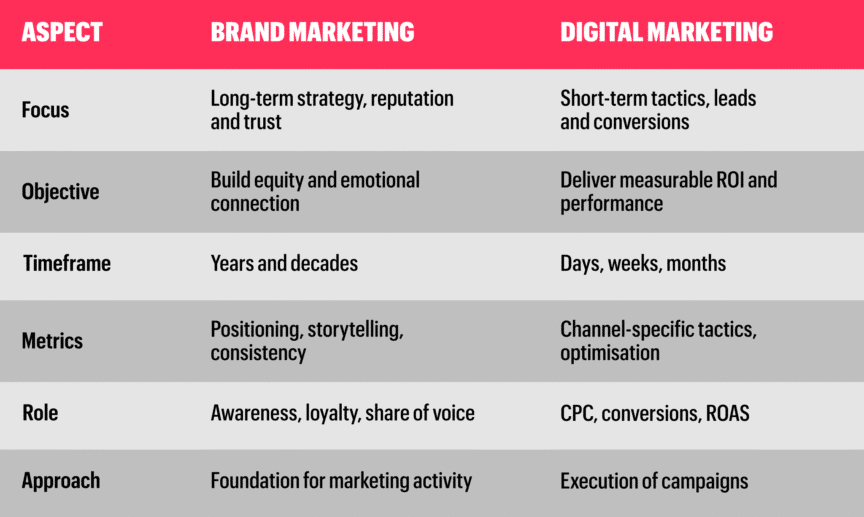
The distinction becomes clearer when you consider what each discipline optimises for. Brand marketing optimises for mental availability—ensuring your brand comes to mind when customers have a need you can fulfil.
Digital marketing optimises for physical availability—making it easy for ready-to-buy customers to find and purchase from you.
Strategy vs tactics explained
Brand marketing is strategic because it shapes how customers perceive your entire category. It answers fundamental questions about positioning: what you stand for, who you serve, and why you matter.
Digital marketing is tactical because it executes specific campaigns designed to achieve particular outcomes within defined timeframes.
This brand marketing vs digital marketing distinction explains why strategy informs tactics, not the other way around. Without strategic brand foundation, digital tactics become random acts of marketing that fail to build lasting business value.
Long-term vs short-term outcomes
The temporal difference creates different success metrics. Brand marketing might take months to show measurable impact on awareness or consideration, but its effects compound and create sustainable competitive advantages.
Digital marketing delivers immediate feedback—you know within days whether a campaign is working. However, these short-term gains require continuous investment to maintain momentum.
Common misconceptions
The biggest misconception is treating digital marketing as a complete marketing strategy rather than a set of tactical tools. Digital channels are incredibly powerful for executing marketing campaigns, but they can’t replace the strategic thinking that determines what those campaigns should communicate and to whom.
Another common mistake is assuming that digital marketing’s measurability makes it inherently more valuable than brand marketing. While digital metrics provide immediate feedback, they often focus on short-term outcomes that may not predict long-term business success.
A campaign with excellent click-through rates might still fail to build lasting customer relationships if it lacks strategic brand foundation.
Many businesses also fall into the trap of channel-specific thinking, optimising for individual digital channels rather than creating cohesive experiences across touchpoints.
This fragmented approach can actually damage brand perception when customers encounter inconsistent messaging or conflicting brand personalities across different digital platforms.
Common pitfalls to avoid:
- Mistaking digital tactics for complete marketing strategy.
- Prioritising short-term metrics over long-term brand health.
- Creating inconsistent experiences across digital touchpoints.
- Neglecting brand foundation while investing heavily in performance marketing.
Why you need both
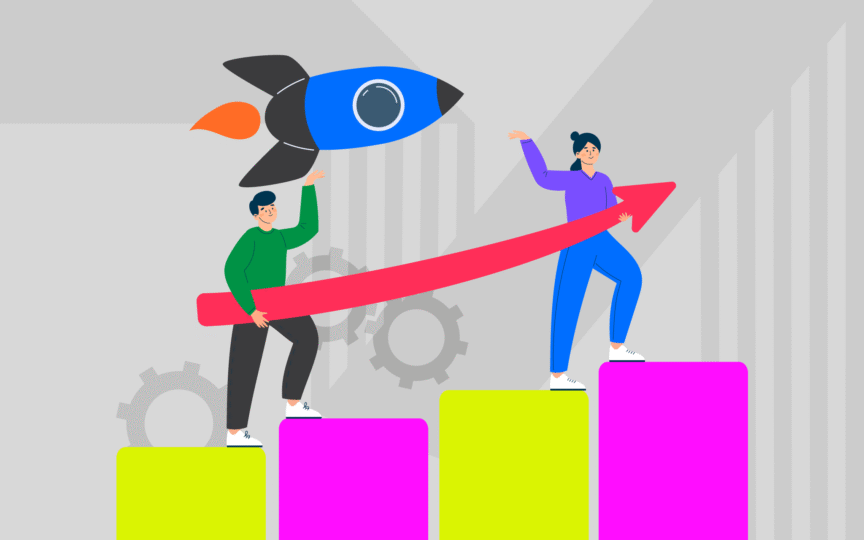
Separating brand marketing from digital marketing creates a false choice that weakens both disciplines. The most effective marketing strategies integrate long-term brand building with short-term digital tactics, recognising that marketing strategy vs marketing tactics requires both strategic foundation and tactical execution.
Strong brand equity makes every digital marketing dollar work harder. Customers who already trust your brand are more likely to click your ads, engage with your content, and convert at higher rates. This brand recognition reduces acquisition costs and improves the efficiency of your digital spend across every channel.
The interplay between brand equity vs lead generation becomes clear when you see how established brands achieve higher conversion rates and lower customer acquisition costs than unknown competitors.
Brand equity fuels digital effectiveness
When customers recognise and trust your brand, your digital marketing campaigns perform better from day one. Higher click-through rates mean lower cost-per-click in paid search. Better engagement rates improve your organic reach on social platforms.
Stronger brand equity translates directly into better digital marketing metrics—creating a virtuous cycle where brand investment amplifies tactical performance. This symbiotic relationship showcases why the brand marketing vs digital marketing debate misses the point entirely—they’re most powerful when working together.
Digital channels amplify brand reach
Digital marketing provides unprecedented opportunities to build brand awareness at scale. Social media, content marketing, and programmatic advertising can expose your brand to precisely targeted audiences across multiple touchpoints.
Digital channels also provide rich data about how different segments respond to your brand messaging, informing future brand strategy decisions.
The integrated marketing mix
The smartest marketing strategies treat brand and digital as complementary forces rather than competing approaches. Brand marketing creates the strategic foundation while digital marketing provides the tactical execution.
This integrated marketing strategy ensures consistent messaging across all touchpoints while maximising both immediate performance and long-term value creation.
When executed properly, an integrated marketing strategy balances short-term digital tactics with long-term brand building, creating sustainable competitive advantages that compound over time.
Key benefits of integration:
- Brand recognition improves digital campaign performance.
- Digital channels amplify brand messaging at scale.
- Consistent experiences across all customer touchpoints.
- Lower customer acquisition costs through improved trust.
- Sustainable competitive advantages that compound over time.

How Fabrik approaches brand-led marketing
At Fabrik, we start with brand strategy before diving into any tactical execution. This means understanding your market position, defining your brand personality, and creating messaging frameworks that guide every marketing decision.
As Forrester Research emphasises in their guidance on formulating marketing strategy, understanding your business context is fundamental to creating effective marketing strategies that deliver sustainable results.
Our approach ensures that your digital marketing tactics serve your broader brand goals rather than working against them. Whether we’re developing your brand marketing services, creating a comprehensive brand strategy, crafting your verbal identity, or designing your visual identity, we build foundations that make every marketing pound work harder.
This brand-first approach means your short-term campaigns contribute to long-term equity building rather than just hitting immediate targets.
Beyond the buzzwords
The debate between brand marketing and digital marketing misses the bigger picture. Both disciplines serve essential functions in a complete marketing strategy. Brand marketing builds the mental structures that make customers choose you when they’re ready to buy.
Digital marketing ensures you’re visible and accessible when that moment arrives.
Success requires understanding that brand equity and digital performance aren’t opposing forces—they’re multiplying ones. Companies that master this integration don’t just grow faster; they build businesses that remain valuable long after their latest campaign ends.
The real difference between brand marketing vs digital marketing isn’t that one is better than the other—it’s that they work best when they work together. Ready to build a marketing strategy that balances long-term brand building with short-term performance? Get in touch with Fabrik today.

Clarity starts with a conversation.
Thanks—we’ll get back to you shortly.
Whether you're navigating a rebrand, merger, or simply need a clearer identity—we’re here to help. No hard sell, just honest advice from people who know the sector.
Let’s start with a simple question…
Prefer to email? Drop us a line.
Fabrik’s been helping organisations rethink and reshape their brands for over 25 years. We’ve guided companies through mergers, rebrands and new launches. Whatever stage you’re at, we’ll meet you there.
