






Brand alignment vs engagement vs culture: Choosing the right intervention

Organisations regularly confuse Organisations regularly confuse brand alignment vs brand culture vs brand engagement. The consequences are costly. Resources get misdirected, initiatives fail to land, and teams stay stuck in the wrong conversation.
Organisations launch culture programmes when what they actually need is alignment. They chase engagement scores without ever clarifying which behaviours matter. Initiatives fail because they target the wrong lever entirely.
The terms are often used interchangeably, but they describe different things, operate at different speeds, and require different interventions. Understanding the difference between brand alignment vs brand culture vs brand engagement helps you choose the right intervention at the right time. Get it wrong, and you’re solving for symptoms rather than causes.
This article clarifies the boundaries between all three, explains how they relate, and helps you diagnose which one your organisation needs to address. Think of it as a map, not a manifesto: designed to help you choose the right tool for the job.
Brand alignment vs brand culture vs brand engagement
The confusion is structural, not semantic. All three concepts relate to people and how they behave. All three appear in the same leadership conversations, usually involving brand, HR and communications teams.
Brand strategy shapes all three, but in fundamentally different ways. The problem is compounded because most organisations never clearly separate them.
They treat culture as a brand deliverable. Engagement is assumed to equal consistency. Alignment is conflated with buy-in.
When the language blurs, the interventions follow suit. Teams invest in the wrong programmes, measure the wrong outcomes, and wonder why nothing changes.

What brand culture actually refers to
Brand culture describes the shared beliefs, norms and unwritten rules that shape behaviour inside an organisation. It’s often emergent, historical and slow to change.
Brand teams don’t own it outright. Leadership, structure, incentives and history shape it instead.
Brand culture sets the environment in which your brand operates internally, but doesn’t guarantee consistency. A strong culture can support the brand. It can also quietly undermine it.
Culture is contextual. It influences whether brand principles take root or get dismissed. But culture alone won’t tell people what to do when the brand conflicts with established process.
What brand engagement really measures
Brand engagement measures energy, connection and sentiment. It’s typically captured through surveys, pulse checks and participation metrics.
High engagement means people care about the brand and feel connected to it. Low engagement signals disconnection or fatigue.
But engagement doesn’t equal consistency. Someone can feel deeply engaged with the brand and still make decisions that contradict it. That’s because engagement reflects how people feel, not necessarily how they act.
The distinction between brand culture vs employee engagement matters here. According to the CIPD, employee engagement centres on emotional commitment to the organisation, while brand engagement focuses specifically on connection to brand identity and values. Understanding brand culture vs employee engagement helps prevent the common mistake of treating cultural norms and engagement scores as the same thing.
Culture shapes the environment. Engagement measures the response. Neither one guarantees that your team will act in line with the brand when it counts.

What brand alignment does differently
Internal brand alignment operates at a different level. It’s the operational bridge between brand strategy and daily behaviour.
Where culture provides context and engagement reflects sentiment, alignment focuses on shared understanding and decision-making consistency. It answers practical questions.
What does this brand mean for my role? How do I apply it when priorities conflict? What behaviours should I reinforce or retire?
Brand alignment is about enabling people to act in line with the brand, not just believe in it. Research from Harvard Business Review demonstrates that when leadership demonstrates aligned behaviour, downstream consistency improves significantly.
It’s less about motivation and more about capability. That makes it faster to influence than culture and more actionable than engagement.
How brand alignment vs brand culture vs brand engagement relate (and in what order)
The relationship between brand alignment vs brand culture vs brand engagement follows a clear sequence. Culture shapes the environment. Alignment directs behaviour. Engagement reflects the outcome.
Culture is the slowest to change. It’s embedded in structure, incentives and history.
Alignment can be built more quickly through clarity, tools and enablement. Engagement is the most visible, but also the most reactive. It tells you how people feel, not whether they’re acting consistently.
When these three are treated as the same thing, organisations waste effort. They run engagement surveys when alignment is missing. They launch culture programmes when behaviours haven’t been defined.
Here’s how they compare:
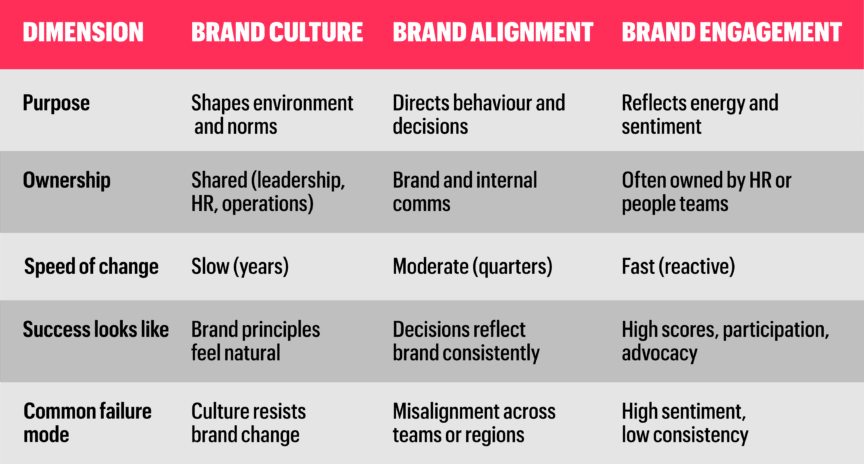
The relationship between brand alignment vs brand culture is particularly misunderstood. Culture provides the soil. Alignment provides the structure.
Without alignment, even a strong culture won’t translate into consistent behaviour. Without supportive culture, alignment efforts feel like compliance.

Common organisational mistakes
Organisations make predictable mistakes when brand alignment vs brand culture vs brand engagement concepts blur. Here are the most common:
- Running engagement programmes without addressing alignment. Scores improve, but behaviour doesn’t. High sentiment doesn’t guarantee consistency.
- Treating culture workshops as brand rollout. People leave inspired but unclear on what to do differently. Cultural change takes years; alignment can happen in quarters.
- Assuming engagement equals consistency. Teams feel connected to the brand but still make decisions that contradict it. Feeling engaged and acting aligned are different.
- Over-investing in values without enablement. Posters go up, but no one knows how to apply principles when priorities conflict. Values without clarity become wallpaper.
- Conflating brand engagement vs employee engagement. One measures connection to the brand. The other measures connection to the organisation. They’re related, but not the same. Conflating brand engagement vs employee engagement leads to measuring the wrong outcomes entirely.
When to focus on brand alignment vs brand culture vs brand engagement
Knowing when to focus on culture, alignment or engagement requires diagnosis, not assumption. Here’s when to focus on each element of brand alignment vs brand culture vs brand engagement:
Start with culture when:
- The environment actively resists the brand
- You see cynicism, passive resistance or gaps between stated and actual values
- Cultural norms undermine brand principles
- Culture work is slow but foundational
Focus on alignment when:
- People want to act in line with the brand but lack clarity
- You see inconsistency across teams, regions or touchpoints
- Decisions don’t reflect brand principles
- Alignment work is structural and measurable
Address engagement when:
- Sentiment is low despite clarity and capability
- You have alignment but motivation is flagging
- This signals a connection problem, not a knowledge gap
- Engagement work is reactive and follows alignment
Most organisations chase engagement first because it’s measurable and visible. But improving engagement without alignment leads to well-meaning inconsistency.
That’s why internal brand alignment is often the missing middle. It’s less visible than engagement scores and less abstract than culture, but it’s the layer that changes behaviour.

Clarity beats activity
Understanding brand alignment vs brand culture vs brand engagement means recognising they’re different tools that do different jobs.
The mistake is treating them as interchangeable. Culture sets the context. Alignment directs the action. Engagement measures the response.
When you invest in the wrong one, you waste effort and dilute impact. The most common gap is alignment: the operational bridge between brand strategy and behaviour.
That’s where clarity and enablement turn intent into consistency. If your organisation is launching culture programmes or chasing engagement scores without addressing alignment first, you’re solving for the wrong problem.
Brand alignment is what turns brand strategy into behaviour. If your teams are inconsistent, unclear or making decisions that contradict the brand, alignment is the missing layer.
Want to understand how brand alignment actually works? Get in touch with Fabrik to discuss how we can help you build consistency at scale.

Clarity starts with a conversation.
Thanks—we’ll get back to you shortly.
Whether you're navigating a rebrand, merger, or simply need a clearer identity—we’re here to help. No hard sell, just honest advice from people who know the sector.
Let’s start with a simple question…
Prefer to email? Drop us a line.
Fabrik’s been helping organisations rethink and reshape their brands for over 25 years. We’ve guided companies through mergers, rebrands and new launches. Whatever stage you’re at, we’ll meet you there.
