
Mastering message hierarchy (from boilerplates to elevator pitches)

Your brand has one story to tell, but dozens of places to tell it. Website headlines, press boilerplates, investor pitches, conference bios—each demands a different length, yet the core message must stay consistent.
That’s where a message hierarchy comes in. It’s your systematic approach to scaling one story across every format, from 150-word company descriptions down to 20-second elevator pitches.
This guide shows you how to build and implement a messaging hierarchy that keeps teams aligned, prevents message drift, and ensures your most important ideas surface first—regardless of space constraints.
We’ll cover practical steps, ready-to-use templates, and real examples that turn complexity into clarity. You’ll learn what is a message hierarchy, how to create a message hierarchy that works, and why your current approach might be holding you back.
Why message hierarchy matters beyond voice
Voice and tone set the style, but substance needs structure, too. Without a clear message hierarchy, teams often create disconnected stories for different audiences, which dilutes impact and confuses prospects.
The same core narrative must work in a detailed company boilerplate and a crisp brand elevator pitch—but compression isn’t just about cutting words. A smart messaging hierarchy puts outcomes before adjectives, proof points before poetry, and action steps before aspirational language.
It’s the difference between rambling through features and landing on benefits that stick. Your CFO needs different details than your newest sales hire, but both should recognise the same strategic priorities and value propositions when you’re done.
When teams understand how to create a messaging hierarchy properly, every touchpoint becomes an opportunity to reinforce positioning rather than confuse it.
Outcomes before adjectives
When attention spans shrink, concrete beats clever every time. Lead with the business outcome you create, add one compelling proof point, then layer in the descriptive details.
This isn’t just about word order—it’s about value proposition hierarchy. Your strongest claims deserve the most prominent positions, whether you’re writing a 120-word boilerplate or a 30-second pitch.

Choose a model: ladder vs house
Two models dominate message hierarchy planning: the message ladder and the message house.
The ladder works vertically—each rung represents a different length or format, from comprehensive to compressed. The house works horizontally—core messages become pillars that support shorter formats across the foundation.
Messaging hierarchy models aren’t about perfection; they’re about picking one approach and sticking with it.
Message ladders suit organisations with linear service offerings or clear customer journeys. Message houses work better for companies with multiple value propositions or diverse audiences who need different entry points to the same story.
The structure matters more than the terminology, and adoption trumps academic precision every time. Most organisations struggle with this choice, defaulting to whatever their last agency recommended or copying competitors.
When you master your messaging hierarchy, you will have a messaging approach that’s easy to use, easy to govern, and consistent across teams.
Message ladder vs message house—practical differences
Message ladders prioritise compression, moving from detailed to distilled. Message houses prioritise pillars, ensuring each core theme gets consistent treatment across formats.
The practical difference shows up in daily usage. Teams using messaging ladders tend to start with the longest format and edit down. Teams using message houses tend to write shorter pieces by selecting relevant pillars from the foundation.

Write the boilerplate the right way
The company boilerplate anchors your entire message hierarchy. At 80–120 words, it’s detailed enough for press releases and partner pages, yet structured enough to compress into shorter formats.
This follows press release best practices that recommend boilerplates between 80-150 words for maximum usability. Avoid the temptation to list every service or mention every client.
Your messaging hierarchy works best when the press boilerplate focuses on primary value propositions and lets other formats handle the nuances.
The 80–120 word range isn’t arbitrary. Research from PR professionals shows this length provides enough space for context without overwhelming busy readers.
Think utility, not poetry—journalists and partners need facts they can quickly understand and credibly repeat. When you’ve got a great message hierarchy, you’re able to write the boilerplate the right way.
Boilerplate vs elevator pitch—different jobs
Your press boilerplate informs; your brand elevator pitch persuades. Both draw from the same message DNA, but serve different audiences with different needs and attention spans.
The boilerplate assumes readers want comprehensive information. The pitch assumes listeners want compelling reasons to continue the conversation. Understanding this distinction helps you avoid the common mistake of reading your boilerplate aloud as a pitch—guaranteed to lose your audience in seconds<.

Like what you’re reading?
We write about branding when we have something worth saying. No schedule. Just substance.
Shrink the story into an elevator pitch
Compression kills weak messages and strengthens strong ones. Your elevator pitch lives at the top of your message hierarchy—20–30 seconds of spoken narrative that captures promise, proof, and next step. No room for company history or comprehensive service lists.
The best messaging hierarchy approaches treat elevator pitches as performance pieces, not written copy. Test yours aloud. Can you say it naturally? Does it flow without stumbling over complex phrases or industry jargon?
Research shows that effective elevator pitches follow a simple formula: hook, problem, solution, proof, and call to action. But the art lies in making this formula feel conversational, not formulaic.
Build around one memorable proof point rather than three forgettable claims. “We’ve helped 200 companies reduce customer churn by 15%” beats “We’re innovative, experienced, and customer-focused.”
How long should an elevator pitch be?
Aim for 20-30 seconds when spoken aloud—roughly 60-80 words of conversational text. Practice with a timer, not a word counter, since natural speech rhythm matters more than precise length.
The 30-second rule comes from real elevator journeys, but applies to any situation where you have someone’s undivided attention for a short time.
Conference introductions, networking events, or those crucial first moments in client meetings all follow the same principle: hook quickly, prove briefly, invite action.

A simple message hierarchy template you can steal
Here’s a practical framework for organising your message hierarchy. Copy it, customise it, and fill in your own content.
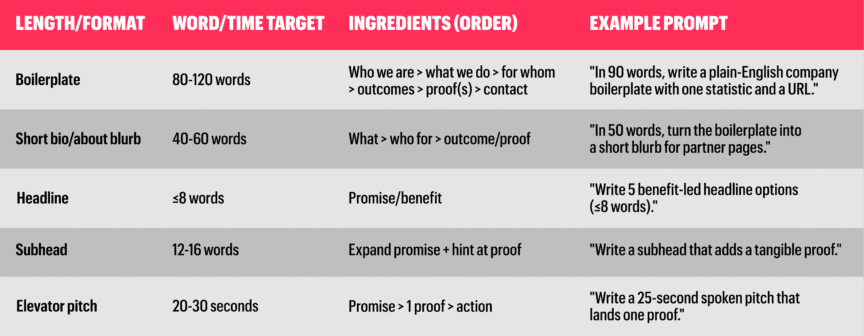
This message hierarchy template draws from years of working with B2B services, tech startups, and mission-led organisations.
This template follows plain English principles—active voice, short sentences, everyday words. Think of it as your messaging ladder in action.
The boilerplate sits at the comprehensive end, providing full context and multiple proof points. The pitch sits at the compressed end, delivering maximum impact in minimum time.
The consistent ordering principle is what makes it work: promise first, proof second, action third.
Whether you’re writing 120 words or 20, this sequence ensures your messaging hierarchy and value proposition stay intact.
Example for B2B services
Here’s how a customer experience consultancy might populate the message hierarchy template…
Boilerplate (95 words):
“DataFlow Solutions helps enterprise retailers turn customer data into loyalty programmes that stick. We analyse transaction patterns, shopping behaviours, and engagement metrics to design personalised experiences that increase repeat purchases by an average of 23%. Our clients include three of the UK’s top ten fashion retailers and two major supermarket chains. Founded in Manchester in 2019, we’ve helped over 150 companies reduce customer churn while boosting lifetime value. From initial data audit to programme launch takes 12-16 weeks. Contact: hello@dataflow.co.uk | www.dataflowsolutions.co.uk”
Short bio (48 words):
“DataFlow Solutions turns customer data into loyalty programmes for enterprise retailers. Our personalised experience designs increase repeat purchases by 23% on average. We’ve helped 150+ companies reduce churn and boost lifetime value. Typical projects run 12-16 weeks from audit to launch.”
Elevator pitch (25 seconds):
“We help fashion retailers turn customer data into loyalty programmes that actually work. Our clients see 23% more repeat purchases within six months. Want to know what your transaction data reveals about customer behaviour?”
Notice how the hierarchy remains consistent—customer data, loyalty programmes, measurable outcomes—but the proof points and calls to action adapt to the format. This example shows how value proposition hierarchy guides format decisions.

Rollout and governance—own it, use it
Even brilliant message hierarchy systems fail without proper rollout and governance.
Assign ownership to someone with authority to make updates and enforce consistency. Usually that’s marketing leadership, brand managers, or communications directors—whoever has both strategic oversight and operational responsibility.
Store your messaging hierarchy where teams actually work: brand guidelines, shared drives, or project management platforms. Include approval workflows for any changes and set regular review cycles—quarterly for fast-moving sectors, annually for more stable industries.
The government’s content design approach emphasises user needs first—apply the same thinking to your internal messaging systems. If your team can’t quickly find the right format for their immediate need, the system fails regardless of its theoretical elegance.
This section will help you understand how to implement a messaging hierarchythat actually gets used, and to create brand guidelines that everyone can follow.

Make it stick across every touchpoint
The best message hierarchy systems don’t just organise content—they change how teams think about storytelling. Instead of starting fresh for each format, you compress and expand from a consistent foundation.
Your messaging hierarchy becomes the bridge between strategy and execution, ensuring every touchpoint reflects the same priorities and proves the same value propositions.
This creates compound benefits over time. Sales teams deliver more consistent pitches. Marketing materials reinforce the same key messages. PR outreach leads with the same value propositions.
The magic happens when your message hierarchy becomes invisible infrastructure. Teams stop thinking about “the messaging guide” and start thinking in terms of outcomes, proof points, and logical sequence.
They intuitively know which elements to emphasise for which audiences, which proof points work best in which contexts, and how to compress complex ideas without losing meaning.
One story, any length—that’s clarity in action.
When you master your message hierarchy, every format becomes an opportunity to reinforce your positioning rather than dilute it. Every conversation becomes a chance to land your value proposition hierarchy with precision and impact.
Need help shaping a message hierarchy that your team can actually use? Talk to our verbal identity specialists.

The agency behind the thinking
Fabrik is a branding consultancy. We help businesses navigate change, build clarity, and create brands that work. Got a challenge? Let’s talk.
Related insights
Connected thinking. Different angles.
The same productive uncertainty.

What is product differentiation? Today, we’re going to answer this question, and provide you with the tools you need to create a successful product differentiation strategy. If you’re ready, let’s get started… As of 2019, there were approximately 41,000 listed companies worldwide, generating a market value of about $80 trillion. Each of those businesses has […]

If you don’t have a strong brand messaging strategy, you have virtually no chance of building a strong relationship with your target audience or boosting sales. After all, your logo and products can only tell your customers so much about your brand. If you want to forge an emotional connection with potential customers, differentiate yourself […]

In a world where consumers are bombarded with thousands of marketing messages daily, your brand personality is either making waves or barely causing a ripple. Let’s be brutally honest – most brand voices sound like they’ve been drafted by a committee, sanitised by legal, and stripped of anything remotely interesting. The result? A sea of […]

A plain-English guide to what brand purpose is, how to write it, and how to make it real. Brand purpose has become the business world’s answer to everything—from attracting talent to driving growth, from weathering crises to winning customer loyalty. Yet for all the evangelical fervour around purpose-driven brands, many organisations struggle to move beyond […]

What is product branding? Today, we’re going to provide you with the complete product branding definition, and help you to discover what it really means to build an identity for a product. You’ve heard of branding for companies, perhaps even personal branding – but what does it mean to create a brand specifically for a […]

As branding experts, we still encounter numerous companies that don’t fully understand why brand positioning is important to their overall growth strategy. Many organizations still assume they can succeed simply by making enough noise in their industry or choosing a competitive product price. However, the reality is brand positioning is crucial for any company. Effective […]
Famous brand positioning examples aren’t just inspirational. They also help to demonstrate just how important it is to capture a place in the mind of your target audience. With excellent brand positioning, companies can gain and preserve their competitive advantage, connect with customers emotionally, and showcase their core values. Brand positioning influences every aspect of […]

The Nike brand positioning strategy is an excellent example of how the right position can make all the difference to a company’s chances of success. Nike has become the ultimate athletic brand by selecting the ideal target audience, championing certain values, and understanding its competition. While countless other companies in the athletic apparel world sell […]

The Starbucks brand positioning strategy is an excellent example of how companies in virtually any industry can become giants with the right branding. Brand positioning captures a place in your customer’s mind as the ideal solution to a specific problem. Through careful positioning, Starbucks has created a name for itself as a company committed to […]

The Coca-Cola brand positioning strategy offers an incredible insight into the power of effective brand positioning in any industry. With the Coca-Cola positioning strategy, the company has effectively set itself apart from every major brand in its industry. Plus, it’s been able to generate a strong emotional connection with every segment of its target audience. […]

In today’s market, brands face a trust deficit. Consumers have endless choice, instant access to competitor reviews, and little patience for empty rhetoric. A brand promise isn’t marketing fluff—it’s the commitment you make every time someone interacts with your business. What is a brand promise in practical terms? It’s the expectation you set and the […]

Marketers love a good overlap. Brand purpose and brand promise blur together. Brand positioning and brand proposition swap places. And somewhere in the middle sits the difference between brand proposition and brand promise – confused with half the terms in the branding handbook. The result? Strategic drift and messaging that sounds convincing but doesn’t land. […]