










Finding your voice—Developing a consistent tone of voice for Royal Colleges

When it comes to Royal Colleges, finding the right voice can feel like walking a tightrope. Lean too far into formality, and the institution risks coming across as stuffy and unapproachable. Swing too far into casual territory, and it might undermine its authority and heritage. Developing a consistent tone of voice isn’t just about how an organisation sounds—it’s about who they are at their core.
Royal Colleges occupy a unique space in the educational and professional landscape. They’re bastions of knowledge, guardians of professional standards, and champions of their respective fields.
But they’re also member organisations that need to engage, inspire and communicate clearly with diverse audiences. This makes tone of voice not just a nice-to-have, but an essential component of their brand strategy.
The challenge for Royal Colleges is particularly nuanced. Founded on principles of excellence and expertise, these institutions carry centuries of heritage in some cases. Their communications need to reflect this gravitas while remaining accessible to modern audiences who expect clarity and directness.
Finding this sweet spot—where authority meets approachability—requires specialised knowledge and experience.
A well-defined tone of voice creates consistency across all touchpoints, from formal academic journals to social media posts. It helps various departments speak with one voice, reinforcing institutional identity and building trust with audiences.
In an age of information overload, a distinctive voice helps communications cut through the noise and resonate with the people who matter to the organisation.
The strategic value of tone of voice
For Royal Colleges, tone of voice is far more than a stylistic consideration—it’s a strategic asset that supports broader institutional objectives.
A well-crafted voice can:
Build trust and credibility: In fields where precision and expertise are paramount, a consistent, authoritative voice reinforces the institution’s position as a trusted source of information and guidance.
Enhance engagement: Communications that balance authority with accessibility are more likely to engage members at all stages of their professional journey, from students to senior practitioners.
Support recruitment and retention: A voice that conveys both prestige and inclusivity helps attract new members while strengthening the loyalty of existing ones.
Facilitate policy influence: When communicating with government bodies and other stakeholders, a clear, authoritative voice enhances the institution’s ability to influence policy decisions.
Improve operational efficiency: Clear guidelines reduce time spent debating stylistic issues and help new staff members quickly adapt to institutional standards.
This article explores practical strategies, real-world examples, and proven methodologies that can help Royal Colleges communicate with confidence, clarity, and consistency.

Understanding your audience
Before putting pen to paper, the most crucial question is: who is the Royal College talking to?
For these institutions, this isn’t a simple answer.
A typical Royal College communicates with:
- Medical students and trainees seeking guidance and accreditation.
- Established professionals looking for continuing education.
- Faculty and examiners upholding standards.
- Policymakers and government bodies.
- The wider public who benefit from the profession’s standards.
- Internal staff and administrators.
- Partner organisations and collaborators.
- Media outlets seeking expert commentary.
- Potential donors and supporters.
Each of these groups has different needs, expectations, and levels of familiarity with the field. Mapping these audience segments and understanding their communication preferences is step one in developing an effective tone of voice.
For instance, while communications with government officials might lean more heavily on formality and precision, outreach to potential new members might benefit from a more accessible, encouraging approach.
The core voice remains consistent, but the tone can flex to suit the context and audience.
Audience research methodologies
Effective audience research employs a range of methodologies to understand expectations:
Qualitative interviews
In-depth conversations with representatives from key audience groups reveal perceptions of current communications and expectations for institutional voice.
These interviews can uncover nuanced feedback that quantitative methods might miss, such as emotional responses to different tones and language choices.
Communication audits
Analysis of existing materials across different channels identifies patterns and opportunities. This includes evaluating not just the words used, but also their effectiveness in achieving communication goals, reader comprehension, and consistency across departments.
Competitor analysis
Examining how other Royal Colleges and similar institutions communicate helps identify best practices and opportunities for differentiation. This can reveal industry norms and highlight areas where an institution might carve out a distinctive voice.
Digital analytics
Engagement metrics across digital channels reveal which types of content and tones generate the most positive responses. Open rates, click-throughs, time on page, and social sharing can all provide insights into what resonates with different audience segments.
Stakeholder workshops
Bringing together key internal stakeholders helps understand perspectives on institutional voice and the challenges in maintaining consistency. These sessions can also build buy-in for the tone of voice development process.
Some younger members may prefer a formal tone in official documents, as it conveys authority and trustworthiness. In educational materials, straightforward and practical language can also be effective.
Insights like these can help institutes refine their communications, balancing credibility with accessibility where it matters most.
Balancing multiple audiences
One of the greatest challenges for Royal Colleges is communicating effectively with diverse audiences.
Several strategies can help navigate this complexity:
Core and flex approach
Defining core voice attributes that remain consistent across all communications, alongside flexible elements that can be adjusted for specific contexts and audiences. This ensures recognisability while allowing appropriate adaptation.
Audience prioritisation
Identifying which audience segments are most critical for different communication goals ensures tone is optimised for those who matter most in each context.
For example, member communications might prioritise practising professionals, while public-facing content might focus on accessibility for non-specialists.
Communication journey mapping
Mapping the typical journey different stakeholders take through communications ensures consistency at each touchpoint while adapting appropriately to their evolving needs.
This might include understanding how a student progresses to trainee to full member, with voice adapting to their changing relationship with the institution.
Segmented content strategy
Developing distinct but related approaches for different audience segments while maintaining a coherent overall voice. This might include varying degrees of formality, technical language, and communication channels based on audience preferences and needs.
Progressive disclosure
Structuring communications to provide essential information accessibly upfront, with more detailed or technical content available for those who seek it. This respects both generalists and specialists, allowing each to engage at their preferred level of detail.

Core principles of Royal College communication
Several key principles underpin effective Royal College communications:
Authority with accessibility
Communications should reflect deep expertise while remaining understandable. This doesn’t mean dumbing down complex ideas—rather, it’s about presenting them in ways that respect the intelligence of the audience while acknowledging varying levels of familiarity with the field.
Effective Royal College communications:
- Use technical terminology where appropriate but provide context.
- Break down complex concepts into manageable components.
- Use analogies and examples to illustrate difficult ideas.
- Structure information logically with clear signposting.
- Focus on clarity rather than simplification.
When one medical Royal College needed to communicate new guidelines to internal teams and stakeholders, Fabrik helped them develop a layered approach—presenting the core information in accessible language with technical details available for those who needed them.
The guidelines were well-received by both audiences who appreciated the technical precision, clarity and context.
Consistency across touchpoints
Whether someone is visiting a website, reading a journal, or attending a conference, audiences should experience the same voice—adapted appropriately for the medium, but recognisably from the same institution.
Achieving this consistency requires:
- Clear guidelines that can be applied across departments.
- Training for content creators throughout the organisation.
- Templates and examples for common communication types.
- Regular review and feedback processes.
- Centralised oversight balanced with departmental autonomy.
This consistency builds trust and reinforces institutional identity. When stakeholders encounter the same voice across different channels and contexts, it creates a sense of reliability and coherence.
It also strengthens brand recognition, helping the Royal College stand out in an increasingly crowded professional landscape.
Values-driven language
Word choices should reflect institutional values. If a Royal College values innovation, its language should feel forward-thinking. If it values inclusion, its communications should be accessible to all.
Value alignment exercises can map specific language choices to core institutional values.
For instance:
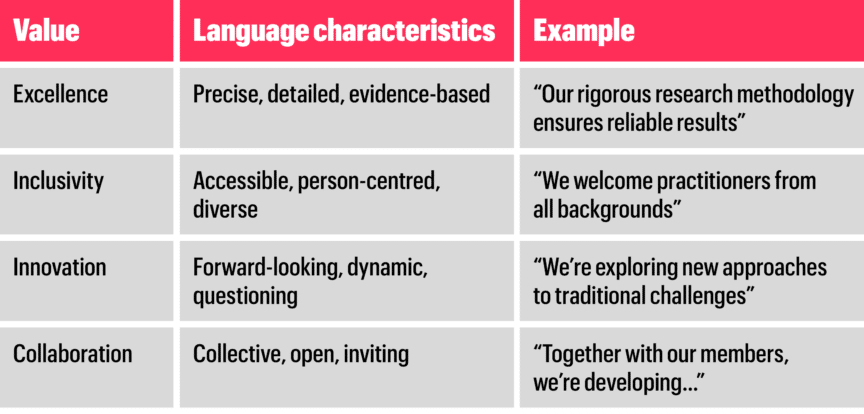
This alignment ensures that communications don’t just say the right things about institutional values—they actually embody those values in their construction and delivery.
Heritage and progress
Many Royal Colleges have centuries of history behind them. Their tone should honour this heritage while feeling relevant to contemporary practice.
Institutions can balance these elements by:
- Identifying language that conveys institutional heritage without feeling archaic.
- Finding modern expressions of traditional values.
- Using historical references selectively and purposefully.
- Evolving traditional formats for contemporary audiences.
This balance is particularly important for Royal Colleges, which must maintain their authoritative position while engaging with new generations of professionals who have different communication expectations and preferences.
Case study: Royal College of Anaesthetists
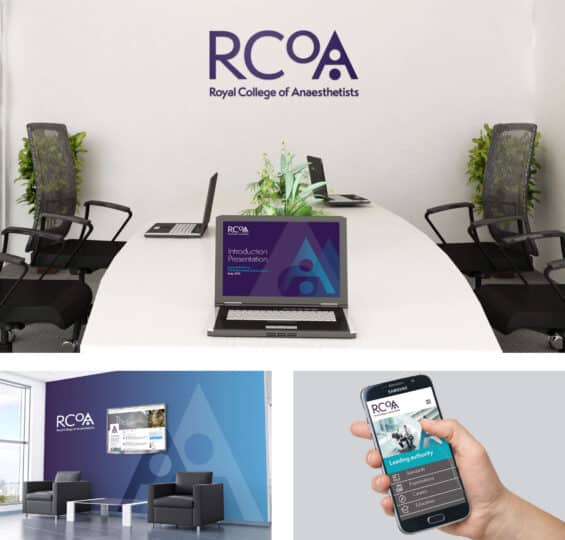
A notable example of successful tone of voice development comes from Fabrik’s partnership with the Royal College of Anaesthetists (RCoA), where we developed a comprehensive brand strategy, including visual identity and tone of voice.
The challenge
The RCoA faced a challenge common to many Royal Colleges: how to honour their prestigious heritage while positioning themselves as a modern, forward-thinking organisation. They needed to communicate effectively with multiple audiences—from medical students to policymakers—while maintaining a consistent brand presence.
As the professional body responsible for the specialty of anaesthesia throughout the UK, the RCoA plays a crucial role in setting standards, educating anaesthetists, and advocating for patient safety. Their communications needed to convey both scientific precision and human compassion—a delicate balance requiring a carefully calibrated tone of voice.
Several key challenges emerged in their existing communications:
- Inconsistency across departments and channels.
- Overly technical language that created barriers for some audiences.
- A formal tone that sometimes felt distant and impersonal.
- Missed opportunities to convey the human impact of their work.
The approach
The project began with deep research into their audiences, values, and communication needs. Stakeholder interviews, reviews of existing communications, and benchmarking against other medical Royal Colleges provided a clear picture of their current position and aspirational direction.
Through collaborative workshops with the RCoA team, Fabrik developed a deep understanding of their institutional values and vision for the future. This informed both their visual identity and their tone of voice.
The tone of voice guidelines developed for RCoA balanced professional authority with clarity and approachability.
Key elements of the new voice included:
- Clear, concise sentences that get to the point quickly.
- Technical language where appropriate, always with context for those less familiar.
- A warm, supportive tone reflecting their commitment to member wellbeing.
- Language conveying confidence and expertise without sounding rigid.
- An emphasis on the human impact of anaesthesia and patient safety.
- A progressive outlook acknowledging both tradition and innovation.
Detailed guidelines with before-and-after examples showed how to transform existing content into the new voice. These examples covered various communication types, from formal policy documents to member newsletters and social media posts.
Results and impact
The new tone of voice helped the RCoA:
- Present a more unified institutional voice across departments.
- Better communicate the human impact of their work.
- Position themselves as both authoritative and approachable.
More details of this project are available in Fabrik’s portfolio.

Developing tone of voice guidelines
Effective tone of voice guidelines need to be both inspirational and practical. They should capture the essence of the institution while providing clear direction for anyone creating content.
1. Voice attributes
The process begins by defining 3-5 core attributes that characterise the voice.
For a Royal College, these might include:
- Authoritative: Conveying expertise and confidence.
- Clear: Making complex information accessible.
- Supportive: Encouraging professional development.
- Progressive: Forward-looking while respecting tradition.
- Inclusive: Welcoming diverse perspectives and backgrounds.
For each attribute, comprehensive guidelines should provide:
- A clear definition that captures its essence.
- The rationale for its importance to the institution.
- Examples of what it sounds like in practice.
- Guidance on how to achieve it in different contexts.
- Contrasting examples showing what it doesn’t sound like.
Here’s an example of how an “Authoritative” attribute might be defined for a Royal College:
Authoritative
Our voice conveys expertise and confidence, reflecting our position as leaders in our field. We speak with conviction based on evidence and experience.
Sounds like: “Based on extensive research and clinical practice, we recommend this approach for patients with complex needs.”
Doesn’t sound like: “Some people think this approach might work better, but it’s just an opinion.”
How to achieve it:
- Use definitive language based on evidence.
- Cite research and expertise where relevant.
- Avoid hedging language (“sort of,” “kind of”) unless expressing genuine uncertainty.
- Use a confident but not arrogant tone..
- Balance authority with accessibility
2. Practical Do’s and Don’ts
Abstract concepts need translation into concrete guidance with examples tailored to specific communication challenges.
For Royal Colleges, these often include:
DO:
- Use active voice to convey confidence (“We recommend this approach”).
- Explain technical terms where they might not be familiar to all readers.
- Address the reader directly where appropriate (“As you progress through your training”).
- Use subheadings and bullet points to improve readability.
- Vary sentence length to create rhythm and maintain interest.
- Use concrete examples to illustrate abstract concepts.
- Reference heritage where relevant, but in a forward-looking context.
DON’T:
- Use unnecessarily complex language to sound impressive.
- Adopt an overly formal tone that creates distance.
- Bury important information in lengthy paragraphs.
- Overuse passive voice, which can create a detached feeling.
- Use jargon without explanation for mixed audiences.
- Forget the human impact of technical information.
- Allow institutional caution to result in vague, non-committal language.
Each point should be illustrated with specific examples drawn from existing communications, showing how to transform them to better reflect the desired voice.
3. Tone adaptation
Detailed guidance on adapting core voice for different contexts while maintaining consistency is essential.
Adaptation frameworks should cover:
Audience-based adaptation:
- How to adjust tone for different levels of expertise and familiarity.
- Specific guidance for communicating with students, members, the public, and policymakers.
- How to maintain voice when addressing international audiences.
Channel-based adaptation:
- Guidelines for website content, social media, publications, and presentations.
- How to adapt voice for different digital platforms while maintaining consistency.
- Guidance for visual content, where text and imagery work together.
Content type adaptation:
- How to apply voice to news announcements, policy statements, educational materials, and member communications.
- Guidance for emergency or crisis communications.
- How to maintain voice in collaborative content created with partner organisations.

Implementation strategies
Developing guidelines is just the beginning—the real challenge is bringing them to life across the organisation. Successful implementation requires both top-down commitment and grassroots enthusiasm.
Training and workshops
A comprehensive training programme tailored to different roles is essential:
Executive leadership sessions: Brief, focused sessions help leadership understand the strategic importance of tone of voice and their role in championing it.
Content creator workshops: Hands-on, interactive sessions where those who regularly produce content learn to apply the guidelines through practical exercises using their own work.
Department-specific training: Customised training addressing the unique communication challenges of different departments, from membership to education to policy.
Train-the-trainer programmes: Equipping key individuals within the organisation to provide ongoing training and support ensures sustainability beyond initial implementation.
Effective workshops go beyond theory, using real-world examples and exercises to help staff internalise the guidelines. Creating safe spaces for practice and feedback builds confidence and competence in applying the new voice.
Content governance
For Royal Colleges with their complex governance structures, establishing clear processes for maintaining tone consistency is essential:
- Creating a small “tone team” who act as guardians of the voice.
- Developing self-review tools and checklists for content creators.
- Setting up peer review systems for collaborative improvement.
- Establishing clear escalation pathways for resolving questions or disputes.
- Implementing periodic content audits to identify areas for improvement.
Phased rollout
A phased approach to implementation recognises that changing institutional voice takes time:
- High-visibility touchpoints (website homepage, key publications).
- Member communications (newsletters, updates).
- Educational materials and resources.
- Policy and research communications.
- Partner communications and collaborative content.
Throughout this process, ongoing support and refinement helps address challenges as they arise and celebrates successes to maintain momentum.

Measuring success
Measuring the impact of tone of voice changes helps demonstrate ROI and provides insights for continuous improvement.
Quantitative metrics
- Readability scores across different communication types.
- Website time on page and bounce rates.
- Email open and click-through rates.
- Social media engagement metrics.
- Member acquisition and retention rates.
- Event registration and participation.
- Enquiry response rates.
Qualitative assessment
- Regular surveys of members and stakeholders.
- Focus groups with different audience segments.
- Interviews with content creators to identify challenges.
- Brand perception research to track shifts in institutional image.
A comprehensive measurement framework can yield significant improvements in engagement, readability, and member satisfaction, showcasing the tangible benefits of the tone of voice project.
The strategic value of Royal College tone of voice
Developing a consistent tone of voice for a Royal College is both an art and a science. It requires deep understanding of the institution’s values, audiences’ needs, and the practical realities of content creation across multiple channels.
A well-crafted tone of voice serves as a powerful strategic tool that can:
- Enhance recognition and memorability among key stakeholders.
- Build trust through consistency and clarity.
- Improve accessibility of complex information.
- Reflect institutional values in every interaction.
- Bridge the gap between heritage and contemporary relevance.
- Unite diverse departments under a cohesive brand voice.
- Create emotional connections with members and stakeholders.
- Support recruitment, retention and engagement goals.
The impact of a well-defined, consistently implemented tone of voice extends far beyond how an institution sounds. It shapes how the institution is perceived, enhances engagement with key audiences, supports strategic objectives, and strengthens the overall brand.
Getting started
For Royal Colleges considering a tone of voice development or refinement project, several initial steps can help pave the way for success:
- Conduct a communication audit to understand your current voice and identify inconsistencies.
- Gather stakeholder input from both content creators and key audience groups.
- Identify core institutional values that should be reflected in your communications.
- Review peer institutions’ communications to understand the landscape.
- Set clear objectives for what you want your tone of voice to achieve.
Specialists like Fabrik bring valuable expertise to this process, having guided numerous prestigious institutions through similar journeys. Our portfolio includes successful projects with institutions like the Royal College of Anaesthetists, demonstrating their understanding of the unique communication challenges these organisations face.
Whether working with an agency or developing tone of voice in-house, remember that this isn’t a one-time project but an ongoing evolution that should grow and adapt with your institution.
The investment in developing a distinctive, consistent voice pays dividends in stronger member relationships, enhanced public perception, and more effective communication of your mission and values.
To explore how your Royal College might benefit from tone of voice development, contact Fabrik at hello@fabrikbrands.com or visit fabrikbrands.com to see more examples of our work with prestigious institutions.
Fabrik: A branding agency for our times.

Clarity starts with a conversation.
Thanks—we’ll get back to you shortly.
Whether you're navigating a rebrand, merger, or simply need a clearer identity—we’re here to help. No hard sell, just honest advice from people who know the sector.
Let’s start with a simple question…
Prefer to email? Drop us a line.
Fabrik’s been helping organisations rethink and reshape their brands for over 25 years. We’ve guided companies through mergers, rebrands and new launches. Whatever stage you’re at, we’ll meet you there.
