
How to create a future-proof housing association brand strategy

A strong housing association brand strategy has always been crucial for community innovators. Whether you’re aiming to become one of the top social housing providers, or a leading vendor of private accommodations in rural communities – branding matters.
After all, it’s your brand that highlights your vision, mission, and company values to stakeholders, from potential tenants, to investors, local authorities, and employees. These days, though, housing association branding is becoming more crucial, and complex.
Mergers and acquisitions are increasing, forcing providers to rework their entire brand identity. Consumer expectations and priorities are shifting, too. For instance, tenants value affordability, transparency, and ESG-driven organisations more than ever.
Achieving (and preserving) success, is all about future-proof branding. We’re talking about branding that ensures your identity can bend–rather than break–when confronted with unexpected challenges, whether those are policy shifts, market changes, or newly emerging community needs.
The pillars of a housing association brand strategy
So, what do housing associations need for a future-proof brand strategy? The path to earning the attention and loyalty of prospective residents, public bodies, and new employees starts with three core pillars – all working together to boost your brand’s potential.
Purpose and mission: Enhancing tenant experience
Your purpose and mission form the heart of your housing association brand strategy.
They outline why you exist to your target audience. You’re not just distributing bricks and mortar – you’re pursuing a specific goal. For example, maybe you’re trying to make affordable housing more accessible to your local community.
Perhaps you’re adding to the housing market, with more environmentally-conscious buildings, designed to reduce waste and carbon emissions.
A clear purpose and mission is a powerful tool – helping you to connect emotionally with tenants and stakeholders beyond the attractive property listings on your website, or your new logo design.
The Cadwyn Group, for instance – is committed to driving a future where people can live and work in more environmentally sustainable homes, workplaces, and communities. They do this by installing solar panels in homes, recycling furniture, and donating food to tenants.
When your brand strategy clearly reflects a mission like that, it resonates more powerfully with tenants and partners alike, reinforcing stakeholder trust and your broader social responsibility.
A stakeholder-centric approach
One of the reasons developing a strong housing association brand strategy is tough – is that housing associations engage with a lot of different “groups”. Connecting with your audience is about more than just community engagement.
You need to earn stakeholder trust from housing authority groups, regulators, employees and more. A stakeholder-centric approach ensures you’re listening to and balancing all these perspectives.
This means exploring various different ways to learn about, and connect with your stakeholders. You might host regular focus groups, to discover the design elements your homes and properties should feature, or conduct proprietary research on smart design strategies.
The more research you do, and the more you listen to your audience across communication channels, the more you’ll be able to differentiate your brand. For example, Southern Housing actively encourages involvement from its community.
It asks existing and new customers to get involved, share their feedback, and provide insights into the customer journey, so it can constantly improve its services.
Long-term vision
Housing association branding needs to be as agile and dynamic as the sector itself. The housing sector is constantly evolving, thanks to digital transformation, new government initiatives, and creative thinking from community leaders.
To stay ahead, and ensure your branding and marketing efforts resonate with younger audiences, and new stakeholders, you need a long-term vision.
Identifying your unique selling propositions (such as your focus on user experience, or sustainable design) is important. But your vision needs to be flexible enough to adapt to changing priorities.
By anticipating change and staying open to strategic moves, housing associations can protect their core values while taking advantage of opportunities to grow.

Key elements of future-proof housing association branding
As the housing sector continues to evolve, future-proof branding is about more than just reacting to the latest trends and important topics in the housing sector.
Safe housing might be a fundamental human need, but the priorities of customers, tenants, and stakeholders are always changing. You need to build adaptability, sustainability and relevance into your branding and marketing strategies to stay ahead.
Here are the key elements of a future-proof housing association brand strategy you can’t ignore.
Clear brand positioning
Brand positioning is all about communicating what makes you unique in a crowded market. Whether you’re building a new brand, or enhancing an existing one, you need to identify, and spotlight what makes you special. That might be affordability, community focus, or service innovation.
Basically, you identify and promote the main reason people choose you over other providers. Brand positioning elevates your organisation’s image and fosters stronger connections with stakeholders.
The Sovereign Housing Association, for instance, positions itself as a company that creates houses where “people love to live”, investing in community wellbeing and safety.
Survey your tenants, staff, and local partners to discover what they value most about your services. Use what you learn to craft a concise positioning statement for your organisation.
A consistent visual and verbal identity
Consistency in housing association branding isn’t just about boosting brand awareness or recognition – it builds trust. When your logo, colour palette, and tone of voice work together seamlessly, people start to feel a deeper connection to your company.
Network Homes, now part of SNG, maintained a unified brand identity by adhering to strict brand guidelines covering colours, typography, messaging, and more. This approach elevated its digital marketing efforts and strengthened brand awareness. Even through its transition into SNG, the emphasis on consistency helped ensure a smooth brand evolution without losing stakeholder trust.
Not sure if your personality, vision, and image is aligned across all channels? Do a regular “brand audit.” Check whether your online channels, printed materials, and tenant correspondence all share the same look and feel.
Robust brand guidelines
Speaking of consistency – behind every future-proof branding strategy is a robust set of rules. Your brand guidelines ensure everyone, from your CEO to each new employee and contractor knows how to present your brand to the world.
Guidelines ensure you can branch out into new opportunities, expand your online presence, and connect with customers, all without compromising on your values or image. Remember to cover every aspect of your identity with yours.
Your guidelines should also include insights into how to use colours and logos on social media platforms, the words to use in campaigns (and language to avoid), and even what your physical assets (like printed materials and signage) should look like.
Digital transformation strategies
Future-proof branding requires companies to embrace digital transformation. Years ago, the best way to connect with stakeholders as a housing association might have been “in-person”. Now, tenants and stakeholders are using various digital platforms to connect with brands.
They’re searching for answers on websites and social media platforms, keeping up-to-date with opportunities through email, and even exploring locations remotely with videos.
Embracing digital transformation isn’t just about designing a new website and making sure your content shows up for a relevant google search.
You’ll need to think carefully about how you can update your brand and marketing strategy to connect with customers across online forums, tenant portals and more.
Don’t underestimate the importance of a strong online presence, that does an excellent job of informing, inspiring, and supporting customers.
ESG alignment
As mentioned above, Environmental, Social, and Governance (ESG) goals are becoming top of mind for stakeholders, from funders to the families living in your properties.
A clear social purpose and a strong focus on protecting the environment will help you stand out in today’s world. However, you need to make your impact clear. Share content about how you’re using eco-friendly building practices, or inclusive hiring strategies.
Introduce stakeholders to your community projects, or the work you do with not-for-profit organisations with online videos. Make it easy for tenants to gain insights into how they can make their properties more environmentally friendly.
In your annual reports, social media updates, or community newsletters, include clear metrics on your ESG goals and progress. Whether it’s the number of homes retrofitted or diversity statistics in your workforce, showing real data builds confidence and credibility.

Future-proof branding through mergers and expansions
At this point, you might be wondering how you can adapt your housing association brand strategy when your organisation grows – through mergers and acquisitions.
A lot of housing associations have joined forces with partners over the years, to access additional resources, fresh perspectives, and new tenants. But there are challenges to consider with any housing association rebrand or update.
For instance, each housing association has its own legacy. Trying to merge two or more brands often raises tough questions: Which visual identity do we keep? How do we unify separate missions? What will tenants think if a brand they’ve trusted for years suddenly changes?
Investing in a few specific housing association branding activities can help, such as:
- Stakeholder workshops: Bring together tenants, staff, community partners, and leadership for open discussions. This collaborative approach surfaces concerns early, clarifies shared values, and ensures everyone feels heard.
- Phased rollouts: Roll out the new brand in steps, testing elements along the way. This gives you time to gather feedback and make adjustments before a full-scale launch.
- Clear communications: Be transparent about why you’re merging, what benefits it brings, and how it impacts each group involved. Consistent updates – online, offline, and in-person – help manage expectations and build stakeholder trust.
A housing association brand strategy in action: Amplius
The merger of Longhurst Group and Grand Union Housing Group led to the creation of “Amplius” – a brand new entity, named and designed by Fabrik, to unify the aligning visions of two separate companies, and prepare the housing association for a future of sustainable growth.
Our approach to future-proof branding started with comprehensive research. We conducted one-on-one interviews, surveys, and focus groups to identify common ground between the merging associations. This research informed everything from the name to the visual style.
“Amplius”– rooted in the Latin word for “further” – reflects a unified ambition to broaden housing services and community impact. A bold colour scheme and modern typeface brought this concept to life – differentiating Amplius as a modern market leader.
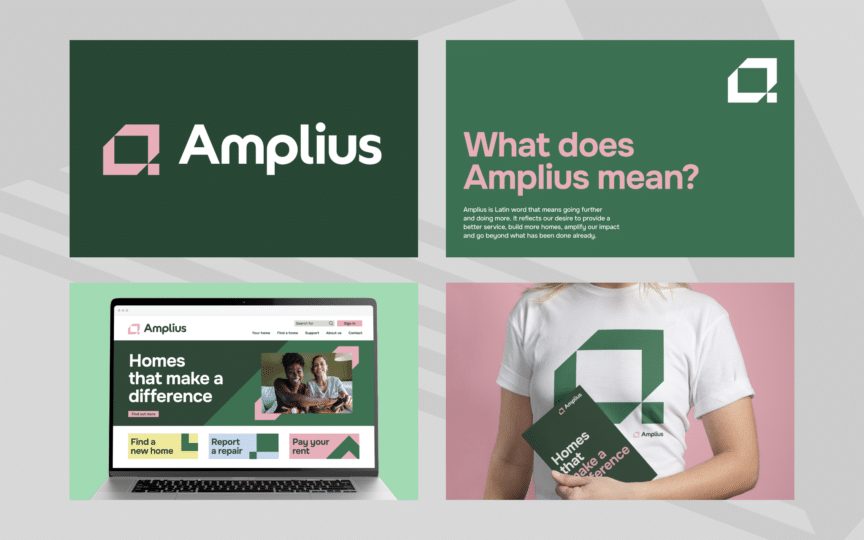
This case study highlights how mergers and acquisitions can elevate brands – if a housing association brand strategy embraces digital transformation, brand identity guidelines, and a shared vision for success.
Strategy is everything.
Like what you’re reading?
We write about branding when we have something worth saying. No schedule. Just substance.
Building a future-proof housing association marketing strategy
One final point to consider when building your housing association brand strategy, is how you’re going to maintain long-term community engagement. That means investing in not just future-proof branding, but a strong marketing plan.
Based on our experience developing marketing campaigns for leading brands, we recommend focusing your attention on:
Community engagement initiatives
Your stakeholders are crucial to successful housing association branding. Don’t just treat them like passive recipients of services. Invite them to get involved in your organisation’s growth. Make tenants part of the brand story, by sharing their case studies and success stories.
Invite them to share their feedback with surveys, polls, and regular forums. Solicit feedback on upcoming projects, and actually use the ideas of your tenants to improve your solutions.
Social media and digital storytelling
These days, social media is often the first place people go for updates. By sharing tenant success stories, project milestones, and behind-the-scenes glimpses, you create a narrative people want to follow – and share with their friends.
Get active on the social channels your customers use, from Facebook and Instagram, to TikTok. Host online community events, and share practical updates (like rent deadlines) online. Forge emotional connections with community stories and volunteer spotlights.
Remember to invest in digital storytelling elsewhere too – on your website, in your email marketing campaigns, and across press publications, to expand your reach.
Campaigns with impact
Whether you’re rolling out new services or highlighting sustainability efforts, targeted campaigns can bring attention to your association’s priorities.
Remind yourself of what sets you apart from the competition, and build your campaigns around that. For instance, if you’re embarking on a green project, document the journey. Share updates through blogs, newsletters, and social media so residents can see tangible progress and contribute ideas.
If you achieve resounding success with a new initiative, like a new housing option designed for younger audiences, share your accomplishments with in-depth stories.

Improving housing association brand strategy success
Finally, if you want to invest in truly future-proof branding – you need to commit to constant measurement and growth.
Identify KPIs for your housing association brand strategy, such as:
- Brand awareness: Check how many people recognise your association through surveys or track online mentions and website visits.
- Tenant satisfaction: Conduct regular feedback sessions or surveys on service quality and gather insights using analytical tools.
- Engagement metrics: Look at social media interactions, event attendance, or email open rates to see if people are actively connecting with your messages.
As you continue to experiment with your housing association branding, and measure your social impact, be ready to adapt. Remember, housing association needs, regulations, and priorities change quickly.
To stay relevant, review your brand guidelines and communication channels at least once a year. Make tweaks when something doesn’t align with your tenants’ priorities or new developments in the sector. Encourage ongoing, open conversations with tenants, staff and community leaders.
This will help you maintain a clear view of how people think and feel about your housing association, so you can take a data-driven approach to growth.

Building a better housing association brand strategy
A strong, future-proof brand strategy goes beyond appearances to shape how your housing association is perceived, trusted, and supported for years to come.
By clarifying your mission, staying consistent in both visuals and messaging, and embracing the flexibility to adapt when circumstances change, you can create a brand that truly speaks to the communities you serve.
At Fabrik, we pride ourselves on helping housing associations cut through the noise and develop authentic, lasting brand identities.
If you’re ready to discover how a carefully crafted housing association brand strategy can elevate your organisation, get in touch. Let’s build a brighter future for housing, together.
Fabrik: A branding agency for our times.
Now read this:
—Your guide to housing association mergers

The agency behind the thinking
Fabrik is a branding consultancy. We help businesses navigate change, build clarity, and create brands that work. Got a challenge? Let’s talk.
Related insights
Connected thinking. Different angles.
The same productive uncertainty.

Housing association merger branding shouldn’t be an afterthought. It’s easy to focus all of your attention on clarifying service options and organising teams during M&A activity. But your approach to branding is often what determines if your evolving venture thrives, or fails. Lately, M&A activity in the housing association sector has skyrocketed for a few […]
What are the different types of branding strategies? It’s a question we hear quite a lot as branding specialists. Branding isn’t just one action, like designing a logo – it’s an ecosystem of connected efforts designed to develop a reputation or feeling. Branding can also apply to a lot of different things. You’ve probably already […]

If you’re wondering how to become a brand consultant, you probably have a passion for helping companies to discover and implement their brand identities. While this career path is still relatively new to the branding world, it’s gaining significant attention as more companies seek help in making their brands as lucrative and effective as possible. […]

Are you wondering how to become a brand strategist? If you have a good understanding of the nuances of the branding landscape, and you love the idea of helping companies grow, this could be the role for you. As a brand strategist, you can quickly become an essential expert for business leaders across the globe. […]

The question “what are brand pillars?” shows up a lot during the early stages of creating a company. When you’re creating a new business, it’s not enough to simply choose excellent products or services to sell. Today’s customers want to form an emotional connection with vendors. Brand pillars are a crucial part of how you […]

A multi branding strategy is the ultimate way to grow your company. Building multiple brands into one entity might seem complex, but it’s a common practice in today’s competitive business world. As marketplaces change and consumer demands evolve, it’s rare to find an evolving business with a focus on a single line of services […]

A corporate branding strategy is one of your business’s most important tools. It defines how you’ll connect with your target audience, showcasing your company’s core values. It also determines how you’ll consistently differentiate your organization from competing companies and how you’ll pursue new opportunities in your market. With your corporate branding strategy, you define a […]
Does your business have a robust internal branding strategy? Most companies know that a solid external brand is important for conveying personality, values, and vision to your audience. But it’s easy to overlook the importance of extending those branding efforts internally. For a company to be successful, it needs to resonate emotionally with more than […]

If you don’t have a strong brand messaging strategy, you have virtually no chance of building a strong relationship with your target audience or boosting sales. After all, your logo and products can only tell your customers so much about your brand. If you want to forge an emotional connection with potential customers, differentiate yourself […]

Your company doesn’t exist in a void. It’s likely one of many organizations competing in the same industry to attract a similar target audience. A brand positioning map is how you determine exactly where your business sits in that larger landscape. When you map your brand’s position in relation to your competitors, you consider the […]

In any industry, great branding is crucial – but strategic brand positioning for pharmaceutical startups is often particularly essential. After all, how you position your company in the pharmaceutical industry doesn’t only influence how well you can earn the trust of potential consumers. Your pharma brand positioning strategy can also impact your ability to attract […]

In a world where consumers are bombarded with thousands of marketing messages daily, your brand personality is either making waves or barely causing a ripple. Let’s be brutally honest – most brand voices sound like they’ve been drafted by a committee, sanitised by legal, and stripped of anything remotely interesting. The result? A sea of […]