








Brand purpose vs brand promise: what’s the difference and why both matter

Too many brands use “purpose” and “promise” interchangeably — and wonder why their messaging feels muddy. The difference between brand purpose and brand promise isn’t just semantic. It’s strategic.
Your purpose is why you exist beyond profit. Your promise is what customers can expect from you, consistently, every single time.
This confusion weakens trust and consistency. Strong brands understand that clarity at this level changes everything. They use brand purpose to guide direction and brand promise to prove they mean it.
Getting clear on brand purpose vs brand promise isn’t just good practice — it’s the foundation of authentic brand strategy. This piece unpacks how alignment builds credibility.
What is brand purpose?
Brand purpose is the reason your brand exists beyond making money. It’s the positive impact you’re committed to making — whether that’s in your customers’ lives, your industry, or the wider world. Unlike a mission statement that explains what you do, brand purpose definition clarifies why it matters.
It’s your brand’s moral compass and long-term strategy rolled into one. Purpose shapes culture, attracts like-minded talent, and drives innovation. It determines which opportunities you pursue and which you walk away from.
Think of it as your brand’s north star. Research shows that consumers pay premium prices for brands demonstrating authentic values and purpose. But here’s the strategic truth: purpose alone doesn’t build trust. You need proof. That’s where promise comes in.
The role of brand purpose
Why purpose gives brands direction, meaning, and social relevance.
Brand purpose isn’t a tagline for campaigns. It’s the thread running through every decision you make. It informs your brand strategy, shapes your brand principles, and acts as a filter for where you invest resources.
Purpose creates emotional connection in branding. It’s what makes people feel something when they encounter your brand. That feeling comes from consistency — doing what you say you believe in, repeatedly, until it becomes indistinguishable from who you are.
The best purposes are simple, memorable, and action-oriented:
- Patagonia exists to save the planet
- Innocent wants to make it easy to do yourself some good
- TOMS exists to improve lives through business
These aren’t vague platitudes. They’re commitments that shape everything from product development to supply chain decisions. These brand purpose and brand promise examples show how the two concepts must work in tandem to create credibility.

What is brand promise?
Your brand promise is the commitment customers can depend on — the experience or value consistently delivered every time they interact with you. While purpose answers “why do we exist?”, promise answers “what will you get?”.
A clear brand promise definition focuses on delivery, not aspiration. Understanding brand purpose vs brand promise means recognising that purpose is internal motivation; promise is external proof. Purpose drives what you believe. Promise validates what you do.

Brand purpose vs brand promise
Here’s where confusion creeps in. Both concepts are fundamental to brand strategy, but they operate at different levels. The difference between brand purpose and brand promise comes down to intent versus delivery, inspiration versus accountability.
Brand purpose vs brand promise isn’t about choosing one over the other. It’s about understanding how they work together. Confusion between the two causes mixed messages and erodes trust. Clarity at this level strengthens both internal culture and customer experience.
To make it clearer, let’s break it down:
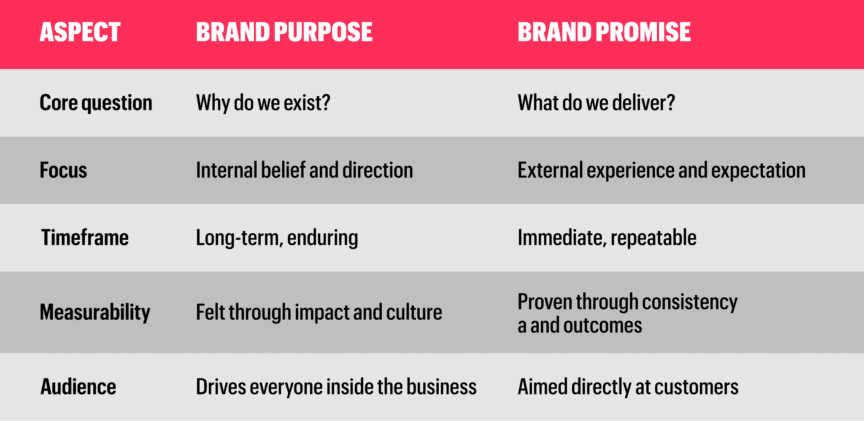
Purpose is philosophical. Promise is practical. The most successful brands don’t treat them as separate ideas. They align both deliberately — using purpose to define direction, then translating that into a credible, deliverable promise that customers experience.
Purpose drives, promise delivers
Purpose inspires intent; promise ensures delivery.
Brand purpose vs brand promise isn’t a competition. They’re complementary forces. Purpose gives you the “why” that attracts talent, inspires loyalty, and differentiates you in a crowded market.
But caring isn’t enough. You need to prove it. That’s where promise steps in.
Think of it like this: purpose is your brand’s heartbeat. Promise is the pulse customers feel. Without purpose, your promise lacks soul. Without promise, your purpose is just talk. Together, they create a rhythm that builds trust and drives brand alignment across every layer of your organisation.

When purpose and promise align
Alignment is where strategy becomes substance. It’s what transforms abstract values into verifiable behaviour — the invisible force that makes brands like Monzo or Waitrose feel credible and human.
When brand promise and brand purpose align, teams unite around shared belief. Customers trust every interaction because consistency breeds confidence. According to Edelman’s Trust Barometer, brands that consistently deliver on their promises see significantly higher trust scores and loyalty.
Think about Waitrose. Their purpose centres on quality, provenance, and doing right by farmers and suppliers. Their promise? Fresh, responsibly sourced food delivered with care. Every shelf, every label, every customer interaction reflects both. The alignment is inseparable.
Or consider Monzo. Their purpose is making money work for everyone, especially those underserved by traditional banks. Their promise is transparency, instant notifications, and fee-free spending abroad. They’ve built an entire brand around delivering tangible, everyday proof of their purpose.
McKinsey research confirms that brands consistently meeting customer expectations see dramatically higher retention, advocacy, and revenue. Alignment turns values into outcomes. It’s what separates brands people trust from brands people tolerate.
Building trust and cohesion
When purpose and promise align, trust follows.
Brand trust isn’t given. It’s earned, one kept promise at a time. Research consistently shows that consumers are increasingly drawn to brands demonstrating authenticity and following through on stated values.
Internal cohesion matters just as much. When everyone in your organisation understands the brand purpose definition and the brand promise definition, they make better decisions in real time. Customer service knows how to respond. Product teams know what to prioritise. Marketing knows what to amplify.
The result? Emotional connection in branding that feels genuine because it is genuine. Alignment creates the invisible foundation of brand success — the element that makes strategy, marketing, and customer experience work together seamlessly.

When purpose and promise clash
Misalignment is where trust collapses. It’s often the gap where credibility dies — slowly at first, then suddenly when audiences notice the disconnect.
Audiences today spot inconsistency fast. Claim an ethical purpose but face backlash for inconsistent practices, and you’ll discover how quickly “purpose-washing” destroys credibility. BrewDog championed progressive workplace culture whilst facing internal allegations of toxic behaviour. Victoria’s Secret promoted empowerment whilst maintaining outdated beauty standards. Both suffered trust erosion.
As Marketing Week reports, customers aren’t fooled by empty commitments. They evaluate brands by how well purpose and delivery match. When your actions don’t match your intentions, customers stop believing both.
The damage isn’t just external. Internal teams feel the contradiction first. If your purpose says “people first” but your promise prioritises cheapest price, employees experience the cognitive dissonance before customers do. Misalignment is toxic to organisational culture. Talent leaves. Innovation stalls. Trust becomes impossible.
These brand purpose and brand promise examples demonstrate how misalignment creates credibility gaps that no amount of marketing can close.
Strategic benefits of alignment
Alignment between brand purpose and brand promise creates measurable business advantage. It’s not abstract philosophy — it’s operational clarity that drives tangible outcomes.
Brands that master brand purpose vs brand promise outperform those that don’t. They attract better talent because people want to work where words match actions. They command higher margins because customers pay premiums for consistency. They weather crises more effectively because trust provides resilience.
Here’s what strategic alignment delivers:
- Faster decision-making: Clear purpose and promise act as filters, making choices obvious
- Stronger internal culture: Teams rally around shared belief backed by proof
- Differentiation: Authentic alignment stands out in crowded markets
- Crisis resilience: Trust built through consistent delivery withstands temporary setbacks
- Customer advocacy: When promise proves purpose, customers become ambassadors
Alignment is the invisible foundation of brand strategy. It’s what makes every other investment — marketing, product, service — work harder and deliver more. It builds the kind of brand trust that turns customers into advocates and employees into believers.

How to audit alignment
Strategic alignment requires honest assessment. Use these reflective checkpoints to evaluate where your brand stands:
Is your purpose clear and understood internally? Ask ten team members to articulate your brand’s purpose. If you get ten different answers, you have clarity work to do.
Does your customer experience reflect what you claim? Map actual touchpoints against stated values. Where do gaps appear?
Are your KPIs and actions consistent with stated purpose? What you measure reveals what you value. If metrics contradict purpose, alignment is broken.
Do employees believe the promise? Your people are your first audience. If they don’t buy in, customers won’t either.
Can you prove your claims? Purpose without evidence is just talk. Track how promise validates purpose across every customer interaction.
This isn’t about perfection. It’s about honest diagnosis — identifying where purpose drives behaviour and where it’s just words on walls. Alignment begins with seeing the gaps clearly.

The future of brand alignment
Brand alignment will evolve from differentiator to survival requirement. Transparency, ethical scrutiny, and authentic brand communication are reshaping how audiences evaluate brands — not just by what they sell, but by how well purpose and delivery match.
Three big trends are reshaping how brand purpose and brand promise work together. First, radical transparency is becoming non-negotiable. Customers fact-check claims instantly. Forbes research highlights that gaps between aspiration and capability kill trust faster than anything else.
Second, ESG expectations are tightening the alignment standards. Stakeholders demand verifiable proof, not performative purpose. Brands like Patagonia succeed because they publish supply chains, carbon footprints, and mistakes. Openness builds trust that glossy campaigns never could.
Third, your promise is becoming part of your employer brand. Employees are the first to feel inconsistencies. What you promise customers signals what you value as an organisation. Talent chooses employers whose internal and external promises align. When those promises match, you attract people who believe what you believe.
Future-proof brands won’t separate internal culture from external promise. They’ll build one integrated alignment strategy that works inside and out. That’s when brand purpose and brand promise stop being concepts and become culture.

Purpose + promise: where strategy becomes substance
The difference between brand purpose and brand promise isn’t academic. It’s the difference between brands that inspire and brands that deliver — and the very best do both.
Purpose drives. Promise delivers. Together, they create the rhythm that builds lasting trust.
Purpose gives you direction, meaning, and a reason to exist beyond profit. Promise gives you accountability, consistency, and proof that you mean what you say. Think of it like this: purpose is your brand’s heartbeat. Promise is the pulse customers feel. Without purpose, your promise lacks soul. Without promise, your purpose is just talk.
The strongest brands of the future won’t just say what they believe — they’ll prove it in every promise kept. Get both right, and you’re not just building a brand. You’re building something that lasts.
To explore how to define and deliver your brand promise in detail, read our full guide: Brand Promise: What It Is and Why It Matters. For understanding how promise differs from brand proposition, explore our comparison.
Need help aligning your brand purpose with a credible promise? Explore Fabrik’s brand positioning services and discover how we help brands turn strategy into substance.

Clarity starts with a conversation.
Thanks—we’ll get back to you shortly.
Whether you're navigating a rebrand, merger, or simply need a clearer identity—we’re here to help. No hard sell, just honest advice from people who know the sector.
Let’s start with a simple question…
Prefer to email? Drop us a line.
Fabrik’s been helping organisations rethink and reshape their brands for over 25 years. We’ve guided companies through mergers, rebrands and new launches. Whatever stage you’re at, we’ll meet you there.
