
Your FinTech brand isn’t broken—but it’s not built to scale

In the fast-paced world of financial technology, growth often outstrips planning. Your brand might have served you well through seed funding and Series A, positioning you perfectly for early success. But scaling a fintech brand requires different strategies than launching one.
Many fintech companies find themselves at a crossroads—their existing brand worked for yesterday’s challenges but feels increasingly inadequate for tomorrow’s opportunities.
The good news? You don’t need to scrap everything and start again.
This article explores how to futureproof your fintech brand strategy without returning to square one, ensuring your brand architecture supports your next phase of growth.
Signs your fintech brand is holding you back
When you’re focused on product development, market expansion, and fundraising, brand inconsistencies can creep in unnoticed.
Here are telltale indicators that your brand isn’t keeping pace with your business ambitions:
- Visual inconsistency across channels: Your website looks polished, but your presentation decks, social media, and product interfaces all follow slightly different rules.
- Poor recognition in new markets: As you expand internationally or into adjacent sectors, new audiences struggle to understand what makes you distinctive.
- Design system breakdowns: Teams create their own interpretations of brand elements because guidelines are insufficient or outdated.
- Messaging misalignment: Different departments describe your company differently—product, marketing, and sales teams aren’t telling the same story.
- Lost differentiation: Your original positioning worked for your niche, but as you broaden your offering, you’re blending into the wider fintech landscape.
Growing pains are normal—but damaging
These challenges aren’t just cosmetic—they represent real business obstacles. Revolut experienced this when expanding beyond its initial travel-focused offering.
Their early, transaction-focused brand struggled to convey trust when they began offering more sophisticated banking services, requiring a strategic evolution of their visual and verbal identity.
Similarly, Klarna’s original brand was designed for point-of-sale financing but became limiting when they expanded into broader financial services. They needed to evolve their brand positioning for fintech growth without abandoning the equity they’d built.
The cost of neglecting these warning signs? Slower market penetration, increased customer acquisition costs, and lost opportunities as your brand fails to open doors the way it should.

You don’t need a rebrand—you need to scale your brand
The term “rebrand” strikes fear into many marketing leaders, conjuring images of massive budgets, disrupted momentum, and potential market confusion. But there’s an important distinction to make: brand evolution doesn’t mean brand revolution.
Brand refresh vs. rebrand: What’s the difference?
A full rebrand typically involves fundamentally changing your market position, name, and core identity—essentially starting from scratch. It’s high-risk, high-disruption, and rarely necessary for growing fintech’s.
A brand refresh, by contrast, is about strengthening and adapting your existing foundations. For fintech scale-ups, this means clarifying brand positioning, improving consistency, and building more sophisticated brand systems that can flex across new channels, products, and markets.
You maintain your recognition while evolving to meet new demands.
Consider UK-based fintech branding for scale-ups like Monzo. Their brand refresh maintained their distinctive coral colour but evolved their visual system to support expanding product offerings and more sophisticated financial services.
When design systems start to fail
As companies grow, design inconsistencies naturally emerge.
What started as a simple logo and style guide becomes insufficient when:
- Multiple teams need to create materials simultaneously.
- Brand applications stretch from mobile UIs to out-of-home advertising.
- International adaptations require cultural sensitivity.
- Product sub-brands need to relate to the master brand.
- Investor communications have different needs than customer-facing materials.
This is where design systems become crucial—not merely as style guides, but as living tools that empower teams to maintain consistency while moving quickly.

Scaling your brand the smart way
Creating a brand built for growth requires methodical thinking rather than reactive fixes.
Here’s how successful fintech companies approach this challenge:
Start with brand positioning
Your positioning must evolve to support your expanded ambitions. This doesn’t mean abandoning what made you special, but rather refining it for broader relevance.
A robust fintech brand strategy for scaling should address:
- Audience expansion: How does your positioning resonate with new customer segments?
- Competitive reframing: As you grow, your competitive set changes. How do you differentiate in this wider context?
- Value proposition clarity: What remains constant, and what evolves as you add products and services?
Starling Bank exemplifies this approach.
They maintained their customer-first positioning but evolved their messaging from being purely about digital convenience to emphasising their full-service banking credentials as they expanded.
Upgrade your design systems
Design systems for fintech need to be both consistent and flexible, enabling efficient production while maintaining quality across diverse applications.
Key components of a scalable design system include:
- Modular visual elements that work across all sizes and formats.
- Detailed typography hierarchies that maintain readability in all contexts.
- Colour systems with accessibility compliance built in.
- Digital component libraries for efficient product development.
- Iconography and illustration guidelines that can expand as needs evolve.
- Animation principles for digital channels.
- Photography direction for different content needs.
These elements should be documented in easily accessible tools, not static PDFs that quickly become outdated.
Align verbal identity with your growth ambitions
Language often receives less attention than visual elements, but it’s equally crucial for fintech scale-up branding.
A comprehensive verbal identity includes:
- Brand voice guidelines that offer flexibility for different channels while maintaining consistency.
- Messaging hierarchies that prioritise key points for various audiences.
- Product naming conventions that create a coherent architecture.
- Content principles for different formats and channels.
- Localisation strategies for international markets.
Wise (formerly TransferWise) exemplifies this approach. Their verbal identity maintained its straightforward, transparent voice while evolving to support a much broader range of international financial services.

Like what you’re reading?
We write about branding when we have something worth saying. No schedule. Just substance.
What brand-led growth looks like in action
Theory is one thing, but practical examples demonstrate the real impact of brand development for scaling FinTech’s.
Salad Money: From visual clutter to a recognisable, scalable identity
Salad Money faced a common challenge—their initial brand had accumulated inconsistencies as they grew, making it difficult to maintain professionalism across channels.
Their brand refresh maintained their approachable personality but created more sophisticated systems that could be applied consistently across all touchpoints.
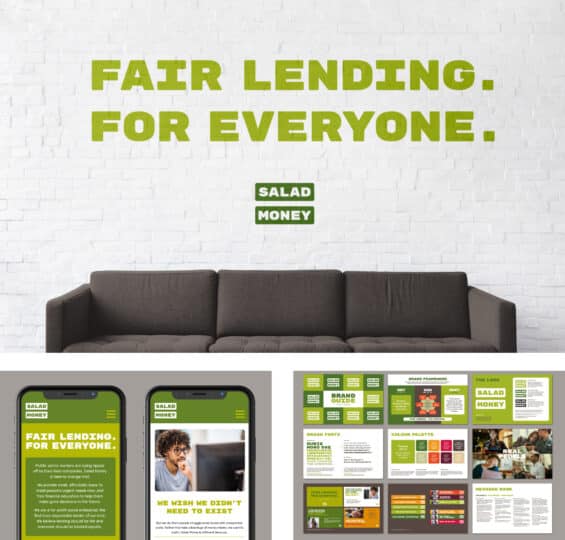
The new design system brought clarity to their communication, while their repositioned messaging better articulated their unique approach to financial inclusion.
The results were tangible: improved conversion rates, stronger stakeholder engagement, and a brand that opened doors to new partnership opportunities.
Fincore: Brand evolution to support product diversification
Fincore demonstrates how a strategic brand refresh can support business diversification. As they expanded their offering from core banking infrastructure to broader financial technologies, they needed their brand to communicate this broader capability.
Their brand positioning for financial technology firms evolved to highlight their expanded expertise while maintaining the reliability they were known for.

Their visual system became more sophisticated, creating a brand architecture that could accommodate various product offerings while maintaining a coherent master brand.
This evolution allowed them to enter new markets with confidence, with their brand effectively communicating their expanded capabilities.

Practical steps to scale your fintech brand
Transforming your brand from startup-suitable to scale-up-ready requires a structured approach:
1. Audit your current brand performance
Begin with a thorough assessment:
- How consistently is your brand applied today?
- Where are the most problematic inconsistencies occurring?
- What aspects of your brand still serve you well?
- What elements create friction as you grow?
This baseline understanding helps prioritise improvements and preserve what’s working.
2. Clarify your strategic direction
Your brand must align with your business strategy:
- What are your growth priorities (new markets, products, customers)?
- How is your competitive landscape evolving?
- What perception shifts do you need to achieve?
This strategic clarity ensures your brand evolves in the right direction.
3. Update your brand framework
With your strategy defined, create a robust framework that includes:
- Refined positioning and value proposition
- Audience archetypes for key segments
- Brand personality and voice attributes
- Key messages by audience and journey stage
This framework becomes the foundation for all brand expressions.
4. Develop comprehensive design systems
Build design tools that enable consistency at scale:
- Visual identity guidelines with usage examples.
- Digital component libraries for product interfaces.
- Templates for common marketing materials.
- Photography and illustration guidelines.
- Animation principles for digital channels.
These systems should live in accessible digital formats that teams can easily reference and use.
5. Create governance mechanisms
Determine how your brand will be managed as you grow:
- Who owns brand decisions?
- How will you onboard new team members to brand standards?
- What review processes maintain quality without creating bottlenecks?
- How will you evaluate brand performance over time?
Good governance maintains consistency without stifling innovation.

Is your fintech brand ready to scale?
A brand built for scale becomes a business accelerator rather than a limitation. It empowers teams, creates consistent experiences, and opens doors to new opportunities.
Most importantly, it grows efficiently with your business rather than requiring repeated reinvention.
Ask yourself these questions to determine if your fintech brand is truly scalable:
- Could a new team member create on-brand materials without extensive guidance?
- Does your positioning differentiate you in your expanded competitive set?
- Can your visual system extend to new applications without breaking down?
- Does your messaging architecture accommodate new products and audiences?
- Do your brand tools enable speed and consistency simultaneously?
If you answered “no” to any of these questions, your brand likely needs strategic attention to support your growth ambitions.
The good news is that evolving your brand for scale doesn’t mean starting from scratch.
Building on your existing foundations—with strategic enhancements and more robust systems—allows you to preserve brand equity while creating a framework built for future growth.
For fintech companies navigating rapid growth, investing in brand development for scale delivers returns through improved market perception, operational efficiency, and the ability to seize new opportunities with confidence.
Ready to future-proof your fintech brand? Start by examining the gaps between your current brand capabilities and your future business ambitions.
The difference represents your brand scaling opportunity—addressing it proactively will turn your brand from a potential limitation into a powerful growth accelerator.
Looking for expert guidance on scaling your fintech brand? Explore our fintech branding services or contact us to discuss how we can help build a brand that grows with your business.

The agency behind the thinking
Fabrik is a branding consultancy. We help businesses navigate change, build clarity, and create brands that work. Got a challenge? Let’s talk.
Related insights
Connected thinking. Different angles.
The same productive uncertainty.

You’re pitching in a few weeks—how ready is your brand? If you’re a FinTech founder, co-founder or marketing lead preparing for a funding round, this guide is for you. Because when you’re seeking investment, you’re not just presenting a pitch—you’re presenting yourself. And that starts with your brand. In the competitive world of early-stage FinTech, […]

The FinTech landscape is evolving at breakneck speed. As venture capital flows and new financial solutions emerge daily, early-stage FinTech founders face a critical strategic decision: chase quick growth metrics through tactical marketing or build brand foundations that support sustainable growth. While many startup advisors push the growth-hacking gospel—promising rapid user acquisition through clever tactics […]

In the high-velocity world of financial technology, scaling up brings a unique set of challenges. For post-Series A and B FinTechs navigating the crucial £10m-£50m revenue stage, sustainable growth isn’t just about technology innovation or funding rounds—it’s increasingly about strategic branding. As competition intensifies and customer acquisition costs soar, branding for FinTech scale-ups has emerged […]

In the rapidly evolving financial technology landscape, enterprises face a constant challenge: balancing innovation with recognition. While product development and technological advancement often take centre stage, FinTech brand guardianship remains curiously undervalued as a strategic growth lever. The most successful FinTech organisations recognise that consistent branding isn’t merely an administrative exercise—it’s a powerful catalyst for sustainable expansion […]

You’ve raised £10 million. Your product’s gaining traction. Customer acquisition is steady. Yet something’s not quite right. Prospects take longer to convert. Investors ask for “more clarity” on your positioning. Your sales team keeps fielding the same basic questions about what you do. Welcome to the world of inconsistent FinTech messaging—the silent killer that’s throttling […]

What is cultural branding? You might have heard of “brand culture”, or “company culture”, but “cultural branding” is a slightly lesser-known concept. The concept essentially applies to infusing your company with a certain “lifestyle” you hope to give to customers and employees. Ultimately, as any great branding company will tell you, the only way to […]

What services does a branding agency provide? It’s a reasonable question to ask if you’re thinking of getting expert help with the process of bringing your brand to life. After all, branding is rarely as simple as it seems on the surface, requiring significant experience and expertise. Often, when companies think about branding, they consider […]

Learning how to start a beauty business from scratch can seem like a daunting prospect for beginners. However, it’s also a fantastic way to transform your passions into a new source of income and growth. After all, the beauty industry is one of the most lucrative, and fastest-growing sectors around. By 2025, the value of […]

As the daffodils bloom and we prepare for Easter celebrations, spring presents the perfect opportunity to refresh your housing association brand. Much like clearing out the winter cobwebs from your home, a strategic brand spring clean can revitalise your organisation’s presence, strengthen stakeholder relationships, and ensure your messaging remains relevant in a changing landscape. Housing […]

In today’s competitive education landscape, further education colleges face a delicate balancing act. Their brands must simultaneously nurture deep local roots while projecting credibility on the national stage. This isn’t merely a communications challenge—it’s a strategic imperative that affects recruitment, partnerships, funding opportunities and institutional growth. At Fabrik, we’ve observed that the most successful college […]

In an industry built on complexity, biotech companies face a unique challenge: how to translate groundbreaking science into stories that resonate with diverse stakeholders. The most successful biotech organisations understand that biotech brand storytelling isn’t just nice to have—it’s essential for growth, investment and market positioning. A thoughtful biotech brand strategy creates the foundation for […]

Branding for Royal Colleges has never been more critical than it is today. These pillars of professional excellence, with heritage stretching back centuries through Britain’s academic and medical traditions, face unprecedented challenges in today’s rapidly evolving landscape that demand more than tradition alone can address. Strategic branding represents not a superficial makeover, but a vital imperative […]